Tuesday, March 13, 2012

Singapore & Saigon -- Welcome to SEA

Prepared March 11 and 12, en route Shanghai, China, and March 13, 2012, Shanghai, China


March 3, 2012, in port Singapore, Singapore:  Visiting Singapore -- One Shopping Center at a Time

J was still recovering from his cold; it was 88 deg F and 90 percent humidity outside; and, we had just been in Singapore in October 2011. (If you are interested in some of the sites of Singapore, see our posts of October and November, 2011.)  Those factors led us to decide to minimize our on-shore time to shopping for some essential items.  Shopping was easy to do, since the Singapore Cruise Terminal is attached to a very large shopping center.  So, after a late breakfast, and letting all the tour enthusiasts off the ship and onto their buses, we proceeded through Singapore immigration, and walked out of the customs and transport hall directly into the shopping center.

 
Welcome to Shopping Center World - Don't Touch the Flowers!

Our first mission was to find a photo processing shop, to convert a digital file image of Cooper into a 5x7 print and buy a frame, so the old boy could be immortalized in our suite.  This required hunting through many miles of shopping center corridors and descending to the lowest basement next to the MRT (Subway) station, until we finally found a small shop that could make the print and sell the frame.  Mission accomplished!

 
Cooper Printed & Framed
With his friends Bird and Dodo

Next, it was to find some intimate clothing that E needed (the shipboard laundry, as good as it is, put some holes in it), which was more of a process, because prices were not to her liking (considerably above Ross' level).   Finally, a store was found, and the items purchased.  Note:  The days of "cheap" Asia are over.  Prices in Singapore are about the same as in the U.S.  On some items, they are much higher, so forget about coming to Singapore to buy inexpensive cameras, etc.  After E overpaid (in her opinion) for underwear, we went in search of a book store.  The day of the giant book emporiums has ended at this mall as well,  and the only bookstore available was one specializing in paperback romance novels and Japanese comic books.  No success on finding any more Carl Hiaasen for J.

Stopping off at Starbucks for a coffee and blueberry muffin, we watched the passing throng of Saturday shoppers.  Regretfully, the Starbucks we picked was next to a childern's toy store, so we didn't so much see the passing throng as hear the passing throng's screaming children!  Returning to the ship,  we had a late lunch, and spent the rest of the day aboard.  This was a very short, less-than-12-hour stop in Singapore, so there really wasn't time to do much sightseeing or visiting old haunts.

Sailing out of Singapore at night is somewhat surrealistic.  When you enter/leave the cruise terminal and pass Sentosa Island, from horizon to horizon are the anchor lights or running lights of other ships.  For the next hour, your ship manuevers in the outbound-traffic lane to clear the port and the anchored ships waiting for cargoes.

 
Sailing from Singapore


March 4, 2012, en route Ho Chi Minh City (Saigon), Viet Nam:  Across the South China Sea

A quiet day at sea sailing in calm waters.  As on any sea day,  it is breakfast, bridge and working on the blog.  J has finally caught up with all the events of our crossing from South Africa to Singapore.  This afternoon, we play bridge and miracle-of-miracles, we finished first, north/south.  It was our first bridge win on the cruise to date, and our Trivial Pursuit team also wins.  Some days are better than others.  To celebrate our victories, we join Don and Kat for an Italian dinner in La Terrazza.


March 5 and 6, 2012, in port Ho Chi Minh City (Saigon), Viet Nam:  Not the City We Knew


Welcome to the NEW Saigon (HCMC)

The Port of  Saigon, Ho Chi Minh City (HCMC) is located about four hours up the Saigon River from its mouth on the South China Sea near Vung Tau .  The Silver Whisper made this river transit in the early- morning hours of March 5 and was docked in the Port of Saigon, near the old French Customs House (now the Ho Chi Minh Museum) by 8:00am.  Since we were not going on tour, we had a leisurely breakfast.  Then, we took the shuttle bus into the center of Saigon, known as District 1, and were deposited across the street from the Rex Hotel.

 
Port of Saigon, HCMC, Old French Customs House

We had hoped to walked around the area and visit old haunts from the 1990s; however, it did not take us long to discover that they were either gone or under renovation.  Gone were E's favorite dressmaker, and under renovation were both of our favorite coffee houses.   After taking some images of the HCMC City Hall and the newly-renovated Opera House, we walked down Dong Khoi Street, did a little shopping, and  went into the Majestic Hotel for a Vietnamese coffee and cake.  The Majestic Hotel, which dates to the French Colonial Period, has been totally refurbished as it was in 1900.  It is like walking into a scene from the movie "IndoChine."  The coffee was, at best, so-so, but the setting was airconditioned wonderful.

 
Ho Chi Minh City, City Hall

 
HCMC City Hall with National Bird (T-Head Crane)

 
Saigon Opera House

Walking around HCMC in mid-day, 90 plus degree F heat was proving a bit much, so we headed for the restaurant where we were to meet JoAnn, Danny, and 7 other members of the bridge corps for a Vietnamese lunch.  The restaurant, Temple Club, so named because it is across the street from HCMC's Hindu temple,  was selected by JoAnn on the basis of internet research.  It post dates J & E's days in HCMC.  It is located in a portion of a former Chinese merchant's mansion that was probably built in the early 1900s.  The interior portion used by the Temple Club has been restored, and it is like walking into a cool, quiet sanctuary with food and drink after the hot, noisy, crowded streets of central HCMC.

After the other bridge corps members arrived, we were seated at a long table in a private dining room.  Menus were passed out, but after a scan by the corps, it was decided that JoAnn and J would order for everyone, which they did with abandon!  By J's count, 14 dishes (2 of each dish) were ordered, including land snails, calamari, pumpkin soup, lotus salad, lemon grass chicken, steamed fish, etc. etc., plus wine, beer and soft drinks.  The food was delicious and plentiful.  After this, dessert was in order for all, with Vietnamese coffee.  Actually, some of us, who will remain nameless, had two, or maybe three desserts.  And, what did this feast fit for the Imperial Court at Hue cost each of us?? -- US$31.00, including drinks and service charge.  There is no better dining experience than an excellent meal, well served and modestly priced.

After lunch, we walked back to the shuttle bus station and waited for our 15-minute ride back to the Port of Saigon.  We boarded the Silver Whisper for a short, post-feast lie down in our suite.

The early evening was a World Cruise Event --Vietnamese Cultural Impression at the Saigon Opera House.   The Opera House was designed in the 1890s by French architect Ferret Eugene, and had been a focus of French culture during the French rule in IndoChina.    During the late 1990s, the Opera House had been closed and appeared nearly direlict in 1995, but it was under restoration by 1998.  J & E had never had the opportunity to see a performance in the Opera House nor the interior of the building, as restorations were not completed until after they had departed HCMC.

About 6:00pm, we boarded the ever-present tourist bus and drove into Central HCMC to be deposited on the steps of the Opera House, where we were greeted by traditional drumming and young Vietnamese dancers in ao dai (traditional dress).  Then, we were given pupus in the foyer that surrounds the hall and stage.  After about an hour of eating and chatting, we were escorted into the theater itself.  It is totally restored with velvet-covered seats, marble floors, and with plaster bas relief of cherubs, etc.  The authorities in their infinite wisdom decided to install a modern, highly-amplified sound system, which was probably not only unnecessary but totally disruptive of the natural acoustics designed into the hall when it was originally built.  The theater holds about  400 persons, so our 50 plus guests appeared a little lost there.

 
Welcome to the Saigon Opera House

J & E at the Opera
Who is happy and who is not!
Photo by Norman Rafelson, Hotel Director


Refurbished Interior of the Saigon Opera House

The performance itself featured a traditional orchestra, beautiful Vietnamese dancers in traditional costumes, and instrumental soloists.  All selections were dumbed down for the western tourists, who probably were perceived by the Vietnamese as incapable of understanding or sitting still through a full-on, traditional, Vietnamese orchestral and folk-dancing concert.  The result of the dumbing down was a performance that seemed amateurish.  A Master of Ceremonies, whose imitation of an American MC, complete with bad jokes, only made things worst.  All-in-all, a potentially elegant, cross-cultural experience was reduced to a series of tired cliches, with little content of merit.  Also, the music blared through an over-amped sound system and clashed with the building's acoustics, making the performance almost painful to listen to.  Finally, after an hour and 30 minutes, we escaped the theater and were back on the buses for the return to the ship.  We never thought that we would ever be glad to get on a tourist bus, but we were after this event!

 
Stage and Dancers  -- Apologies for the Large Objects Blocking View

The morning of March 6 proved bright and sunny, with temperatures in the 90 degree F plus range.  J and E decided that since they had not booked any tour, or had any specific reason to go back into the city, they would stay aboard and enjoy a leisurely day without the heat, noise and crowds of central HCMC.  Lazy, very lazy!  This decision was reinforced by the Silver Whisper's early 3:30pm departure from HCMC.  Since it was 11:00am before we were even organized to think about going ashore, our lack of interest was reinforced by the short time left.

3:30pm came and passed, and we did not sail.  The Captain announced an undefined technical problem had to be resolved before we could depart.  It was 5:00pm before we actually sailed.  (The choice of sailing at 5:00pm was reinforced by the port rule that no ships, except container ships, may begin transit of the Saigon River after 5:00pm, and the thought of spending twelve more hours tied up in Saigon harbor probably did not appeal to the Captain.)  With the assistance of a tug, we turned 180 degrees in the middle of the Saigon River and started the long 4-hour transit downriver to the South China Sea at Vung Tau.
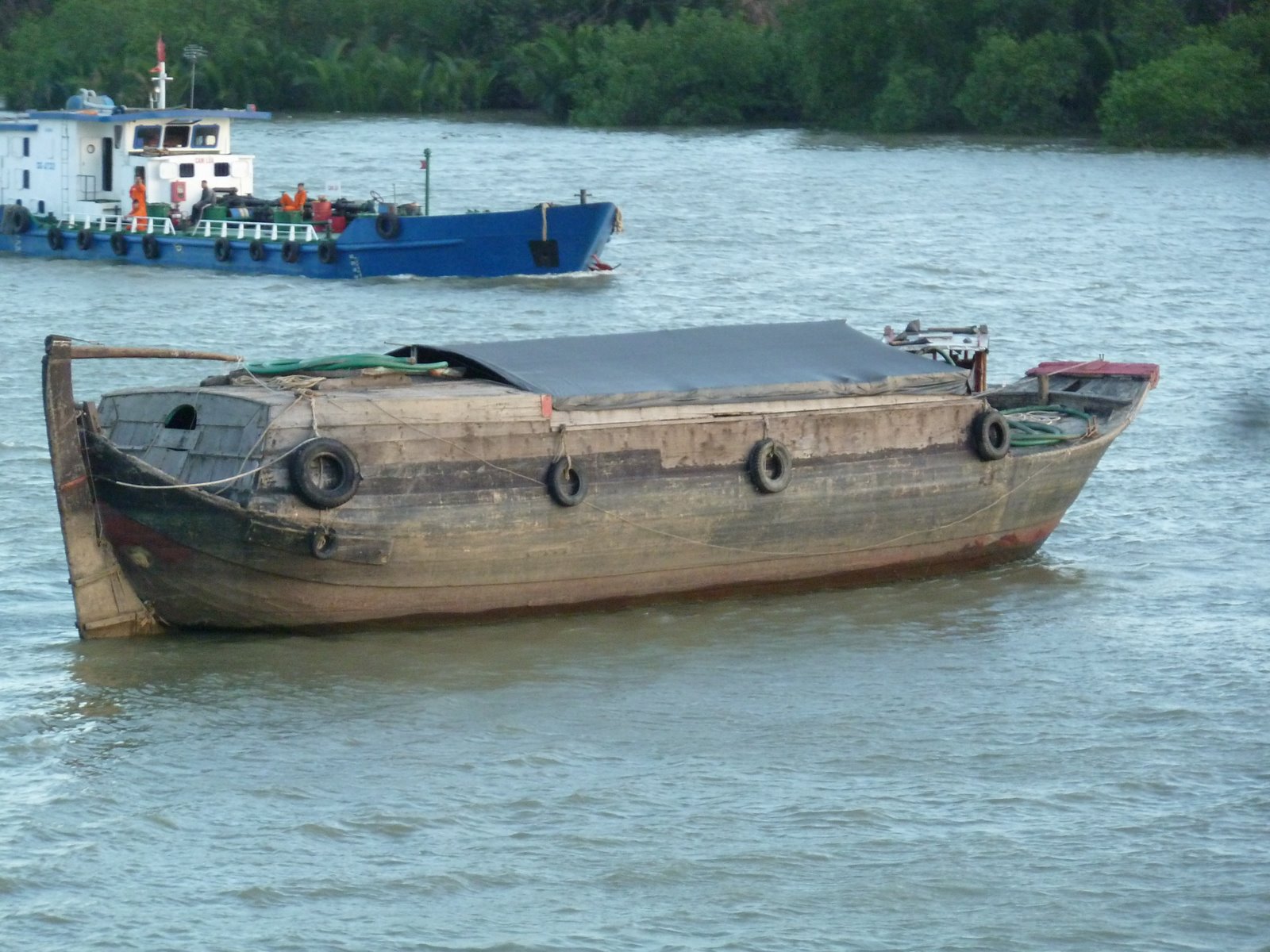
 
Traditional Rice Barge -- Saigon River

 
Port of Saigon, Saigon River View

Our transit downriver revealed the great size of HCMC, which spreads along the Saigon River for much of the first 20 miles.  The river scene gives one a view of new buildings, port facilities and bridges that have been constructed in the last few years.  As darkness settled, we gave up sightseeing from our cabin patio and went to a special dinner for World Cruisers on the pool deck at the Hot Rocks Cafe.  (Hot Rocks is a self-cooking experience on super-heated, granite rocks, not an activity much favored by J & E.  Self-cooking is NOT why we go on cruise ships.)  From the Pool Deck, we could still watch the lights of the towns and ships, as we finished the long river transit and turned north northwest toward Hong Kong and the land of the Dragon Throne.

 
Port of Saigon - New Container Facilities

 
GE Wind Turbines, Port of Saigon

 
Bridge over Saigon River


Posted by Picasa

Thursday, March 8, 2012

In India's Sunny Clime

Prepared March 7 and 8, 2012, en route Hong Kong, China


February 24, 2012, en route to Chennai (Madras), India:  Chronicles

Departing Colombo, we turned south and rounded the southern tip of Sri Lanka before turning north-northwest toward Chennai, formerly Madras.  Looking at a map, one would find this route strange.  Why not sail directly north from Colombo and sail through Adam's Bridge and the Palk Strait that separate India from Sri Lanka at the northern end of the Island of Ceylon?   The reason is that at certain times of day, the water in the region of Adam's Bridge is too shallow for safe passage of a ship that draws as much water as the Silver Whisper.  So, the transit to Chennai is along the eastern side of Ceylon.

One stable of cruising is the daily plan-of-the-day, called the "Silversea Chronicles," in the case of the Silver Whisper or any Silversea ship for that matter.  The next day's Chronicles is normally found on your bed in the evening before the day it concerns.  The format is fixed, so there is not much variation in topics covered.  Page 1 tells you the date, where you are, where you are going, and the dress code for that evening.  Many passengers forget these things on a regular basis.  (It's the passenger demographic!)  Also, page one will contain a short article, probably "liberated" from the internet, on such topics as our next port of call, oceanography, regional religions, etc.  In other words, filler material.  Page 2 contains advertising for commercial activities on Silversea: "Your next cruise is waiting"; The on-board shops and spa -- "Be forever covered in mud" or some other suspicious substance---visit The Spa of Silversea; and, the on-board casino - "We will make your money our money!"

Page 3 is the heart of the matter.  A minute by minute list of activities on board from sunup to midnight, or later.  Those activities include physical fitness, internet support, contests, "enrichment lectures," bridge lessons and play, afternoon tea , Bingo and Team Trivia, and various evening entertainments.  All this is fitted neatly on one page.  Page 4 contains brief writeups of some of the events.  For example, on February 24, the four  articles enlighten guests on "Artist Michel Bell," "Fancy Dress Making Contest," "Water Volleyball, Did You Know?," and, "Martini Demonstration."  Fascinating, absolutely fascinating!  Next, there are inserted menus for lunch, afternoon tea, and dinner, followed by Page 5.

Page 5 contains more brief writeups of on-board activities, which you will be spared from knowing to keep you from falling asleep while reading this.  Well, maybe not, they do give flavor.  Today, they include the ad for Le Champagne, and notes on "Cocktail of the Day," "Wellness Breakfast on the Pool Deck," "Ever wanted to Learn Napkin Folding?," and "Join Us for a Wiener Kaffee."  Finally, we reach Page 6, which is devoted to "Meal and Snack Hours," "Bar Hours," "Ship's Directory,"  (Yes, after nearly two months, we still have people who can't find things, including E.)  and, "Today's positioning of Silversea's Fleet."

So, now the passenger is informed.  It is hard to miss that a vast majority of the content concerns food and drink.  And, if you haven't guessed, this is the most important information sought by the passenger.  Where and when is their food, and where and when are their drinks?


February 25, 2012, in port Chennai (Madras), India:  Silversea Scholars

Chennai (Madras) was a new port for J & E.  J had worked there in the 1970s and '80s but had never returned to Chennai or the Tamil Nadu region of India as a tourist.  There were several interesting tours, including a seven-hour bus safari to Mahabalipuram, a 7th and 8th Century AD temple complex carved into rock outcroppings.  However, the thought of another case of bus butt was too much.  So, we chose an architectural tour of Chennai.  The tour was limited to 10 people and conducted by a local itinerate academic, Dr. Suresh.

We met Dr. Suresh and our fellow "Silversea Scholars" on the pier and boarded a 16-passenger minibus for the tour.  The title of "Silversea Scholar" was Dr. Suresh's.  He needed something to call us and thought this most appropriate -- the verdict is still out on that.  After traveling only a short distance, we left our bus, crossed a major Chennai street (a real heart stopper, that!), and entered Fort St. George.  Since Fort George (as it is commonly known) is the seat of the First Minister (Governor) of Tamil Nadu and an active military garrison, only selected buildings were available to tour, and no non-governmental, official vehicles were allowed in the Fort.  Another "Mad Dogs and Englishmen" experience was at hand!

The first building was the St. Mary's Church, the oldest Anglican Church in India.  The church was built to be not only a place of worship, but a shelter for civilians during war time.  It was last used as a bomb shelter during WWII, when Japanese air attacks were feared.  (Chennai was shelled by the Imperial German cruiser SMS Emdem during WWI.)  The building is a massive structure, with 5-foot thick walls and fort-like portal doors.  Inside, the church is rather plain, except for all of the commemorative plaques to the members of the congregation who died for the British East India Company and the British Empire in India.  There are a great number of plaques!  Among those of repute are Clive of India, who was married in the church, and Eli Yale (of Yale University fame), who worshiped there.  The impression that a walk through St. Mary's leaves you with is:  the life of the British Raj during the 17th and 18th Centuries in India was short and maybe not as posh as portrayed in fiction!  (Unless you consider a rather large tombstone posh.)


Exterior, St. Mary's Church, Fort St. George


St. Mary's Is A Very Sturdy Church
Yes, those are the grave stones of the Raj!


Interior Altar View, St. Mary's Church
The plaques commemorate the men and women who gave their all for the Empire.


More Testament to the Price of Empire

The next stop was the Fort St. George Museum, an 18th Century British East India Company building that has served many functions, but in the 19th and 20th Centuries, at least until 1947, it had been a British Officers' Club.  After Indian Independence and the British quit India, the building became a museum dedicated, more-or-less, to the artifacts of the British period in India.  There were rooms dedicated to militaria, household items, paintings of British governors, etc.  The two most interesting items were the statues of Lord Cornwallis and the Duke of Wellington.   Cornwallis, of the loser of the Battle of Yorktown to Gen. Washington fame, went from the Americas to India.  In the service of the British East India Company, he bashed about a number of Indian Rajas and the French to gain military fame and a statue (formerly outside, under a cupola).  Wellington, victor of Waterloo and the campaigns in the Peninsula (Spain and Portugal), gained much of his early military experience in India.  So, their statues (which were considered inappropriate for display in the open following independence) have been moved into the museum.


Interior, Fort St. George Museum
Lord Cornwallis Statue


No, It Is Not Darth Vader!
Statue of the Duke of Wellington

Leaving Fort St. George, we drove by the building of the Chennai High Court.   This building, considered by many to be the largest high court complex in the world, was built by the British in 1892 and has towers and turrets in the Indo-Saracenic style, typical of much of the Imperial architecture in India.  Also, in the later British Empire style is the municipal building of the Chennai Corporation.


Chennai Railroad Station
An example of  late British Empire Architecture


Chennai Municipal Corporation Building
Late British Empire Architecture

Our final stop was the Government Museum at Egmore.  This building complex, which houses theaters, archaeology and natural history museums, is a large collection of Indo-Saracenic architecture built of red brick.  Most of our time here was spent visiting the stone and the bronze statuary collections.  Those collections are largely of Hindu/Buddhist gods and goddesses.  Without an intimate knowledge of Hindu/Buddhist mythology,  the statues of the gods displayed begin to run together.  However, this does not detract from the quality of the craftsmanship represented by individual pieces.


Exterior View Government Museum Egmore


Typical Red Brick, Government Museum Egmore


Stone Buddha


Stone Hindu Goddess


Stone Elephant Statue

The bronze collection is housed in a newly-modernized gallery, which has air-conditioning.  The air-conditioning definitely improved the attention span of the Silversea Scholars; even though their ability to discern the difference between one dancing Shiva and another did not seem to improve much.  The bronze collection is of significance, because many of the statues were crafted in Tamil Nadu between the 7th and 15th Centuries.


Bronze Dancing Shiva

After the museum, it was back to the baby bus and a tour along the Chennai seafront on Marina Drive, arriving back at the Silver Whisper about 1:30pm.  By this time, Chennai had reached temperatures into the low 90 Deg. F and humidities in the 80 percent range.


Marina Drive and Beach, Chennai
Gratefully, this was not our bus!


February 26, 2012 to March 3, 2012, en route Port Blair, Andaman Islands, India; in port, Port Blair, Andaman Islands; en route, Phuket, Thailand; in port,  Phuket, Thailand; and en route, Singapore:  Confined to Quarters

On returning to the ship from the Chennai tour, J began to develop symptoms of a cold.  This cold had been about the ship since Fort Lauderdale, but both J & E had avoided contracting it.  Well, J's luck ran out, and for seven days, he was out of action and did not leave the room in the hope of not spreading the cold to other passengers or members of the crew.  E became his faithful caregiver.  Not an easy task, at the best of times.


The Sick Room!
Actually, our suite on the Silver Whisper

Finally, by day four, the home remedy approach was shelved, and the ship's doctor was visited.  Mostly, this resulted in more powerful cough medicine with codeine (yum-yum), cold medicine, and an antibiotic for symptoms of respiratory infection.   Recovery then began to take hold, or because of the "good" drugs, J just didn't notice the cold anymore.

During those seven days, we lived entirely in our stateroom, and it was definitely getting smaller by the end of the confinement.  Our butler, Mary Ann, served our meals and brought us anything we required from outside, while Regan, our room steward, kept the place in order.  We read, wrote on the blog, played cards, watched TV and movies, and looked out the window.  Such an exciting cruise!

As proof of life, J has included images of the ports at Port Blair and Phuket.  J's condition was rapidly improving as we approached Singapore.  Although he still had some minor symptoms, he was declared 90 percent fit and allowed out of the room for a short time on March 3, as we passed through the Straits of Malacca.


Port Blair, Andaman Islands, India


Port, Phuket, Thailand


Sunset, Straits of Malacca


Posted by Picasa

Monday, March 5, 2012

Into the Land of the British East India Company

Prepared March 4 and 6, 2012, en route and in port, Ho Chi Minh City (Saigon), Viet Nam


February 22, 2012, en route to Colombo, Sri Lanka:  A Very Small Reward

Although the Indian Ocean pirate zone extends to the Cape of Coromandel at the southern tip of India, after departing Male, the pirate issue and the resulting ship's precautions seemed to gradually disappear.  By the time we arrived in Colombo, the pirates were history!

We sailed northeast from Male, passing south of Coromandel on a nearly straight-line course for Colombo.  The weather was squally, with wind and rain following one after another.  During this time, the on-deck passenger contingent suffered from not baking on deck.  Now, any hardy soul could get a deck chair without squabbling with someone who claimed generational ownership of said deck chair back to William the Conqueror.  Squabbling over pool-side deck chairs is a major activity of the "bake in the sun" subset of passengers.  And "ownership" of deck chairs is hotly disputed.  It seems that the German and English contingents are often involved in those disputes.  That may by just a feature of demographics, as they make up a large element of the current passenger list.

Tonight's dress code for dinner is formal.  So, it is into the monkey suit and the gown for the two of us and off to a ritual event called the Venetian Society Cocktail Party, which preceded tonight's dinner.  At this event, people are rewarded and awarded with pins for having sailed on Silversea for so many days.  The rewards start at 100 days, when you receive free laundry.  In many ways, this is the most sought-after reward.  It is held in much higher regard than the Venetian Society pins, which have small (miniscule) precious stones to identify how many cruise days you have sailed.  It's the thought that counts.


February 23, 2012, in port Colombo, Sri Lanka:  Visiting a Grand Dame

Docking in the port of Colombo on the morning of February 23 was an interesting experience.  We have been in the port on three other trips since 1997, and it always seemed quiet and not very busy.  This morning, that was definitely not the case.  There was shipping everywhere, and it was extremely busy.  We were assigned a berth at the far end of the container port area; probably lucky to get a berth in the port at all.

Since J had worked in Colombo, and both of us had visited on other occasions, we decided not to take a tour.  Instead, we opted to retain a car and driver for a trip to the Mount Lavinia Hotel.  J had wanted to show the hotel to E since he first visited Colombo in 1980, but events had always transpired so that it was never feasible.  However, this time we finally arranged to see it.

The Mount Lavinia is a sister hotel to Raffles in Singapore and The Strand in Yangon.   All were established in the 19th Century to accommodate the travelling Raj of the British Empire.  The original (main) building was built in 1806 by the British Governor of Ceylon, Sir Thomas Maitland.  It was built outside the city of Colombo to help conceal the governor's love affair with a Mestizo dancer, named Lovina.  (Yes, dear, even the Raj did it!)  Passing in and out of British government hands, in 1877, it became The Grand Hotel, Mount Lavinia  (some say a corruption of the good governor's mistress' name, Lovina.)  Since 1877, except for WWII, when it was used as a military hospital, it has operated as a resort hotel.


Mount Lavinia Hotel
Center portion is original 1806 building

We had thought we were going for a drive into the countryside south of Colombo along the coast, as was the case in 1980.  We did go south from the port, which is located very near the center of Colombo, but we never reached the rice paddies of rural Sri Lanka.  It seems in the 30-plus years since J's original visit, the hotel had moved into the suburbs of Colombo!  (Actually, the city has expanded outward, and now, it reaches well past Mt. Lavinia toward Kalutara on the road to Galle.

We arrived at the Mt. Lavinia and went to a patio/pool area for a coffee.  A look around the pool deck at the hotel buildings quickly revealed the impact of 25 years of civil war between the Sinhalese and the Tamils.  The buildings, although clean and orderly, were in need of serious maintenance.  For example, in some places, plaster facades were chipped and falling off.   Generally, the property looked like it had seen better days and was in serious need of an upgrade.  After we finished our coffee, we walked around the grounds, taking photos and looking at the buildings.  The most impressive is the original 1806 governor's residence, built in the late colonial Georgian style.  It is now squeezed on both sides by additions, probably dating to the early to mid-1900s.  All-in-all, the hotel needs renovation, such as has been done to Raffles' original buildings or The Strand, to bring it up to international standards.  One suspects that this will happen in the near future, as it is obvious from our drive around Colombo that economic activity is picking up rapidly since the Tamil Tiger War ended.


View of Colombo from Mt. Lavinia Veranda


Mt. Lavinia Hotel 1806 Building 


Mt. Lavinia Hotel - 20th Century Building


Mt. Lavinia Hotel Colonade


Mt. Lavinia Hotel -- Landscaping

Our driver rescued us from the hot noon sun and suggested, since the car was ours until 2:00pm, a little City tour.  This was fine with us, except that we needed to make one stop at an optometrist's shop to find a pair of "fit-over" sunglasses for J, since we had failed to find them in Mauritius.  Well, at the first shop we visited, they had a pair of fit-overs, so that allowed time for us to drive through the City and see some of the important sites, including the Municipal Building, Independence Monument, a Buddist temple, and the new, Chinese-built stadium.  Also, we got to see the hectic street life of Colombo.  Although traffic was not Bangkok "bad,"  it was congested enough to make crossing the street on foot a very exciting experience.


Colombo Municipal Building


Buddha Statue, Colombo City Park


Independence Monument, Colombo


Statue, Buddhist Temple, Colombo


J & E at Buddhist Temple, Colombo

Returning to the ship,  we thanked/tipped our driver and climbed the gangway to Deck 5 in the boiling afternoon sun, glad to be back and in the air-conditioned hull of the Silver Whisper.

Posted by Picasa

Friday, March 2, 2012

Pirates of the Indian Ocean and the Big Tuna

Prepared March 1, 2012, in port, Phuket, Thailand


February 17 to 20, 2012, en route to Male, Maldives:  "High Risk Area for Piracy"

On returning from dinner on the evening of February 16 (still in port in Port Louis, Mauritius, taking on fuel), a two-page letter from the Captain was delivered with the ship's plan-of-the-day (Silversea Chronicles) for February 17.  The letter began with the following paragraph --

On the evening of February 18th 2012, whilst underway toward the Maldives, the Silver Whisper will be entering the portion of the Indian Ocean which together with the Gulf of Aden, the Arabian Sea, and the Red Sea has been designated by the International Maritime Organization as High Risk Area for Piracy.  Acts of piracy reported in this region by Somali Nationals, have been affecting several ships transit in this geographical part of the world.

The letter went on to attempt to describe the threat, ship's countermeasures, and actions to be taken by passengers if the ship were to be attacked by Somali pirates.

Before turning to priacy, the Somali national livelihood was stealing cattle.  The Swahili word for any Somali is shifta, which literally translates as "cattle thief."  When not stealing cattle from other Somalis, the Somalis would raid eastern Kenya and steal cattle there, until the Kenyan government set up a special force, called the BDU (Border Defense Unit).   Over the years, the BDU curtailed shifta cattle raids into Kenya, and in the process, they drastically reduced the number of shifta!  One can only wonder if yesterday's shifta cattle thief is today's shifta pirate.  An old Kenya hand, who J met when we lived in Kenya, summed up Somalis this way -- :"The women are the most beautiful in the world, and the men are worthless."

Because of the pirate threat, our course to Male, Maldives was modified.  Normally, the ship would take a northeasterly course, approaching Male from the western side of the Maldives;  however, our course took us due east from Port Louis, until we passed south of Diego Garcia Island.  Then, we turned north-northeasterly, approaching Maldives from the eastern side.  This course added about 12 hours sailing time to the Port Louis - Male leg of our journey.  The modified course reduced the risk of piracy, because it put us near the U.S. base on Diego Garcia, probably an area less frequented by pirates.  Even ones who chew kat.

On the afternoon of February 18, the Captain held a meeting with passengers and reiterated the security points in his letter, emphasizing the very limited possibility of actually encountering pirates, and discussing the ship's countermeasures in a general way.  After the briefing, he asked if there were any questions.  Big mistake!  Since the questions were nearly endless, and mostly irrelevant to any piracy attack not conducted by Gilbert and Sullivans' Pirates of Penzance, only the winning question will be immortalized here.  Question:  "If the pirates get on the ship, should we lock our valuables in the safe?"  Answer:  Long pause, followed by, "That should not happen."  To paraphrase Kermit -- It is not easy being Captain.

Starting at or about sunset on February 18, our butler came in and closed the drapes.  The ship was to be blacked out from dusk tell dawn.  This darkened-ship exercise is difficult on a cruise ship.  The evening of February 19, we were with Enzo, the Guest Relations Officer, and one old trout commented that as soon as the butler left, she opened the drape.  She wanted "to see out."  One can only guess how many other trouts also wanted "to see out."  Anyway, the effort was made!

Sea days were largely spent the same -- bridge lessons and bridge play.  Bridge is a very frustrating game, best summed up as -- the more you improve, the worse you get!  J & E continue to improve, having moved to the middle part of the rankings instead of being permanent anchor, but on some days, it is back to anchor.

Late evening on the 19th, we passed about 70nm south of Diego Garcia and changed course to the north-northeast, making for Male.

February 20th was a special day - E's birthday.  Even though she tried very hard to keep it from leaking out on the ship, the ship's company knew and so did many of our passenger friends.  Although initially not intended to celebrate E's birthday, we had ordered a special roast duck dinner with Danny and JoAnne, and Richard and Robert.  For the dinner, we had three crispy roast ducks, wurst, rotkohl, and hot German potato salad.  A real German dinner.  The duck was superb.  Even J, who is not the world's biggest duck fan, had a second portion.  It was truly a wonderful meal.  When we arrived back in our cabin, we discovered it had been decorated with birthday ballons and rose petals, plus rose.  Also, there was a small chocolate mousse birthday cake and birthday greetings from the Captain and our cabin staff, Mary Ann and Regan.  So, we topped off the crispy duck, with half the chocolate mousse birthday cake.  We couldn't let it get stale.


February 21, 2012, at anchor off Male, Maldive Islands:  The Big Tuna

Having escaped the grip of Black Beard (or would it be Black Abdul), the pirate and his jolly band, we arrived off Male, the capital of the Maldives.   About 10:00am, we anchored and launched the tenders by 11:00.  J & E had not made any plans for going on tour, so after the tours had departed, we went ashore to walk around Male and to visit the local museum.  The tender docked in Male's small boat harbor at the local interisland ferry pier, and it was a beehive of activity with numerous fishing boats and interisland ferrys loading and off-loading.

After disembarking, we walked across the main road past  the Friday Mosque and into a small park that had been the Sultan of the Maldives' old palace grounds.  The palace, a modest wooden structure, still is standing, but was not available for touring.  Also, the National Museum was closed, so cultural tourism in Male came to a dead end.  Walking back to the port, a local man gave us directions to the markets, and we walked along the pier side to visit two different vegetable markets, and the fresh fish market.


Friday Mosque - Male, Maldives


Cannons Outside National Museum

Why there are two vegetable markets was not clear to us, probably the growth of Male required additional market space, and there was not space directly available at the old market site.  Or, as E pointed out, the one vegetable market (closest to the pier) may have been to provision ships and the outer islands and was for men only, and the other, closer to the town and out of the port area, may have been for local consumers, both men and women.  This was supported by the gender of the customers in the two markets.  Both markets were well stocked, with tropical fruits and vegetables, including some that we did not recognize.  For example, there was the "pinenut" fruit, which appeared to be a mutant relative of a pineapple.   However, the sample given us by the local vendor tasted more like an apple or pear.  The image of the pinenut fruit below gives you some idea of its size.  A monster.


Local Vegetable Market


Mysterious Pinenut Fruit


Closeup of Mysterious Pinenut Fruit

Leaving the second vegetable market and our encounter with the pinenut fruit, we visited the fish market.  It was about 1:00pm and the local fishing fleet had returned with numerous yellow fin tuna (ahi) which were being laid out on the concrete floor of the local fish market (suisan) just like in Hilo or Honolulu.  Here, we met our ship's Executive Chef and two ship's officers buying fresh fish for the ship's table.  It was very busy at the fish market and along the pier, as the catch-of-the-day was carried or wheeled from the pier to the market.


Fishing Fleet is in Port


Big Tuna on the Move


Tuna by the Bucket


Executive Chef Finding the Right Fish

As we were leaving the fish market, a local man asked us if we were interested in antiques or souvenirs.  Lacking anything better to do, we walked  a short distance up a side street and up the stairs into a very large souvenir shop -- anything you desired, new or used, from the Maldives (supposedly).  Having enjoyed the day, and since we were the only ones in the shop, J bought a Maldives t-shirt, but it is now E's t-shirt (like it or not), because it shrank from XL to XS on first washing!  Well, what can you say!  Anyway, we did a little bit for the tourist sector of the Maldives' economy.

Returning to the pier, we waited (with other Silver Whisper passengers) for the tender, and watched the local scene.  Since it was 1:45p--before the Restaurant closed, we had a light lunch, followed by, in J's case, a long nap in preparation for a rigorous round of trivial pursuit and dinner for two in the Resturant.  At dinner, we were served absolutely the best fresh Trevally direct from the fish market in Male!   Our Executive Chef has a good eye for fish.


Returning to the Silver Whisper


With Dinner in the Bucket!


Posted by Picasa