Monday, August 20, 2012

The Land Common Sense Forgot


Fujairah, Dubai, United Arab Emirates (UAE)


Prepared August 20, 2012 at home Kona, Hawaii


April 9 and 10 at sea northern Indian Ocean enroute to Fujairah, UAE:  Back in Pirate Waters

Silver Whisper departed Mumbai at 11:00pm on 8 April heading west northwest.  We were back in pirate waters with the ship darkened and additional security in place.  Our next destination was the UAE port of Fujairah on the northeast coast of the Arabian Peninsula.  There were, of course, the usual lectures, entertainments, and special meals to distract passengers during our two-day crossing.  And, there was the rumor mill, which was busy with pirate adventures.  About the only real event was the Hotel Director Norman and F&B Manager Sujith's wine and cheese event to introduce a collage of images which they had taken during the cruise.  The collage was well done, and we have a copy somewhere in the house of mementos.

Our cruise across the northern Indian Ocean was uneventful and we docked in Fujairah, UAE at 8:00am on the morning of April 11.   One does wonder what would happen if pirates did board a cruise ship.   It would probably play out a little like John Hughes' novel, "A High Wind in Jamaica," with the pirates returning to their assault boats in a state of shock after being nearly heckled and nagged by the Mad White Women who make up most of the cruise passengers.  Remember, these women are experts; many of them have heckled and nagged at least one husband to death, and no small number have put down more than one.  No wonder pirates avoid cruise ships like the plague.  Note:  A movie version of "A High Wind in Jamaica" is available for the more image-oriented reader.


April 11 in port Fujairah, UAE:  A Visit to Lulu's

As described in the one piece of tourist literature provided to the passengers before disembarking, Fujairah is "the authentic Emirati city nestled between the Haja Mountains and the Arabian Sea."  The visual impact is of a number of modern buildings stuck in the desert.  Fujairah's primary function is to support tankers and other ships waiting outside the Strait of Hormuz to charter and load cargoes in the Arabian Gulf.   There are probably between 50 and 100 hulls anchored off Fujairah at any one time.


Fujairah's Skyline
Sorry about the sandstorm.

J & E's big adventure in Fujairah was to take the ship's complimentary shuttle bus to the Lulu Mall, City Centre.  The approximately 10 minute (five mile) trip from ship-side in the port to the mall was essentially a complete city tour without a guide's description.  Not a building looked over ten years, the streets were not congested, and the parking lots were so big you could get heat stroke walking from the lot to any of the buildings.  There may be some traditional Arab souks and forts in the area, but they are lost among the new buildings, roads and parking lots.

Lulu's is Walmart of the Arabian peninsula, and provides a shopping opportunity for ship's company and passengers to stock up on junk food and other "essentials" at reasonable prices.  This is where the local expats and foreign workers come to shop and to buy presents to sent back to Pakistan, Bangladesh, or the Philippines.  The amount of luggage, electronics and saris for sale was amazing.  No photos inside the Centre!  After taking in this local adventure in modern Gulf shopping, (J used an ATM machine and bought a box of pencils for the trivia team) we reboarded the shuttle and  returned to the harbor.  

Much of the rest of the day was spent observing activity in the port.  The most interesting point was speculating about the submarine, apparently under repair, tied up across the harbor from us.  I doubt if there was a single male passenger who didn't check it out with the binoculars provided in the stateroom.  Consensus  guess is that it was a British Navy nuk-boat undergoing some kind of repair or reprovisioning.  Here's an image -- make your own guess!


Name That Submarine
Tankers laying-off in the background.

At 5:30pm, we got underway and sailed north along the coast toward the Strait of Hormuz, and onto Dubai, UAE.


A Sandstorm Sunset on the Arabian Peninsula
Sorry about the spots on the image, a camera sensor problem.


April 12 and 13 in port Dubai, UAE:  Welcome to Cloud-Cuckoo Land

At 8:00am, the Silver Whisper docked at the Port Rashid Cruise Terminal in Dubai.  We had not planned any tour activity for Dubai, since we had been in the city many times since the 1980s when J advised a UN-supported project there.

Our big event in Dubai was to have high tea at At.mosphere Restaurant on the 121st floor of the Burj Khalifa, currently the world's tallest building.  With our friends Kat and Don, we left the ship about 2:00pm  and were driven to the Burj Khalifa.  After passing through several checkpoints, we were allowed to enter the building.


Burj Khalifa, World's Tallest Building
(Wikipedia stats.)
SkyscraperBurj KhalifaUnited Arab EmiratesDubai829.84m2,722.57ft201025°11′50.0″N 55°16′26.6″E

Since we were early for our reservation, we were "invited" to wait on the floor above the concierge desk until it was "time" to take the express elevator to the restaurant.  The floor above turned out to be the lobby of the flag ship Armani hotel, and old Georgio had done himself proud.  The lobby was all pale grays and other what E calls "Georgio colors."  (E is a big Armani fan.)


Escalator to Burj Khalifa Main Entrance
Yes, it is all glass and stainless steel.


Kat, Eloise, Jerry & Don, Armani Hotel Lobby
Glass, stainless steel, and Armani colors.

Precisely at 3:30pm, we were summoned to the entrance level, escorted aboard a very high-speed elevator, and shot up into the sky 120 floors.  If you were a religious person, you might have started praying about 30 seconds into this elevator ride.  About 60 seconds after leaving the lobby, we arrived on the 120th floor, and  were introduced to At.Mosphere's maitre d'.   She checked our reservations and led us to a table on the 121st floor, and tea was served.  Tea was very heavy, with two large tea trays filled and refilled with goodies until waddling was all the movement possible.


Decisions, Decisions!
Eloise faces the tea tray (one of two) at At.mosphere

Sadly, Dubai was in the midst of a sandstorm, so visibility was not great; however, the image that follows will give you some idea of how high up in the air we were.


Looking Down from At.mosphere
Covered area at left is the Dubai Mall


See, Guinness Says So!
World Record Certificate for "highest restaurant."

Back on the express elevator and the fun of falling like a rock for 120 floors - that could have unsettled all the food, but it didn't.  Then, the building concierge called for our car.  (We doubt that they would let you in  if you drove a private car!)  While waiting, J took a few more images of the Burj Khalifa's interior.  And then it was back in the car and on the streets to the Mall of the Emirates to watch some skiing!


Glass Panels and Louvers, Burj Khalifa's Lobby


Yard Art, Burj Khalifa's Lobby
You have to wonder whose cousin did this!

Back in the van, we were driven southeast toward the Mall, a super-sized, enclosed shopping center whose major claim to fame is that it houses the "Only Indoor Ski Slope in the Middle East -- Ski Dubai."  No foreign tourist worth their passport could possibly miss seeing an indoor ski slope in the middle of a desert during a sandstorm!  Our driver dropped us off, and after assuring us that we could find our way back to the pickup point, we began the trek through the endless cornucopia in this temple to excess consumption.  After walking for at least 15 minutes, we arrived at Ski Dubai.  Yes, a little Swiss Alpine village with ski and sled runs, lifts, and people in ski clothes.  All that was missing was Julie Andrews singing "Edel Weiss."   There were enough children about that no more were needed to sing the chorus.


Interior View, Mall of the Emirates
We have anything your heart desires for a price.


Looking into Ski Dubai
Think of it as a zoo for snow things.


Part of Ski and Sled Runs
Where is Julie Andrews when you need her.


Ski Dubai, Yes You Can Rent the Clothes
One suspects these outfits are not part of most locals' wardrobes.

After inspecting this triumph of engineering over common sense, and watching some attempts by paying customers to ski (not very well) down the run, we walked back through the mall and returned to our car just in time to participate in Dubai's rush hour(s) traffic, thereby enjoying an extended view of blowing sand from the car window. We eventually made it back to Port Rashid, tipped the driver, and walked up the gangway to the relative sanity of the Silver Whisper.

Our second day in Dubai was Friday the 13th.  Of course, we paid no great notice to this long-standing superstition.  After breakfast, we decided to join in what appears to be the singular most important recreational activity in the UAE -- visiting a mall! -- and boarded the Silversea shuttle bus to the Dubai Mall.  It is another super-sized enclosed building (acres under roof) located adjacent to the Burj Khalifa.  (The building where they serve tea.)  After a 15-minute bus ride from the port to the mall, the bus parked across from it in a vacant, very large bus-parking lot.  We were pointed across the street and told to walk until we found an entrance.  So much for Arab hospitality.  It doesn't extend to anyone not in a chauffeured limo (certainly not a bus).

The Dubai Mall is reputed to be the largest mall in the world with 1,200 plus shops.  However, one mall is very much the same as any other.  Except for lots of corridors with little foot traffic, thus facilitating a leisurely stroll, a stop for a cup of coffee at Starbucks, and buying some birthday cards, the whole experience was like Ala Moana in Honolulu, less crowded.  There was one challenge.  The structure is so large you can get lost!  We didn't, but we came close!


Dubai Mall Exterior
The number of people queued up to enter is amazing.


Botero Fat Horse, Dubai Mall Plaza
Not for sale!

The area between the mall and the Burj Khalifa consists of a courtyard and an artificial lake with waterfall.  This courtyard contains a piece of yard art by Botero.  Botero must have made a fortune doing yard art for new, "up scale" shopping areas.  There also is one -- a fat chicken -- in Singapore near the Fullerton Hotel and several fat nudes in the new Rupungi District of Tokyo.  Anyway, while J was taking his photo, one of our fellow passengers approached and explained that he had two Boteros.  J, ever the wit, said, "They must take up most of your living room."  Probably the humor was lost, but sometimes you can't resist!  J also holds that Botero is largely responsible for the growing number of fat people in the world.


Dubai Mall, Water Feature
Always hearing about the "Lion of Judah," this must be it!


Dubai Mall, Shopping Arcade
Please form orderly queues to enter the shops.
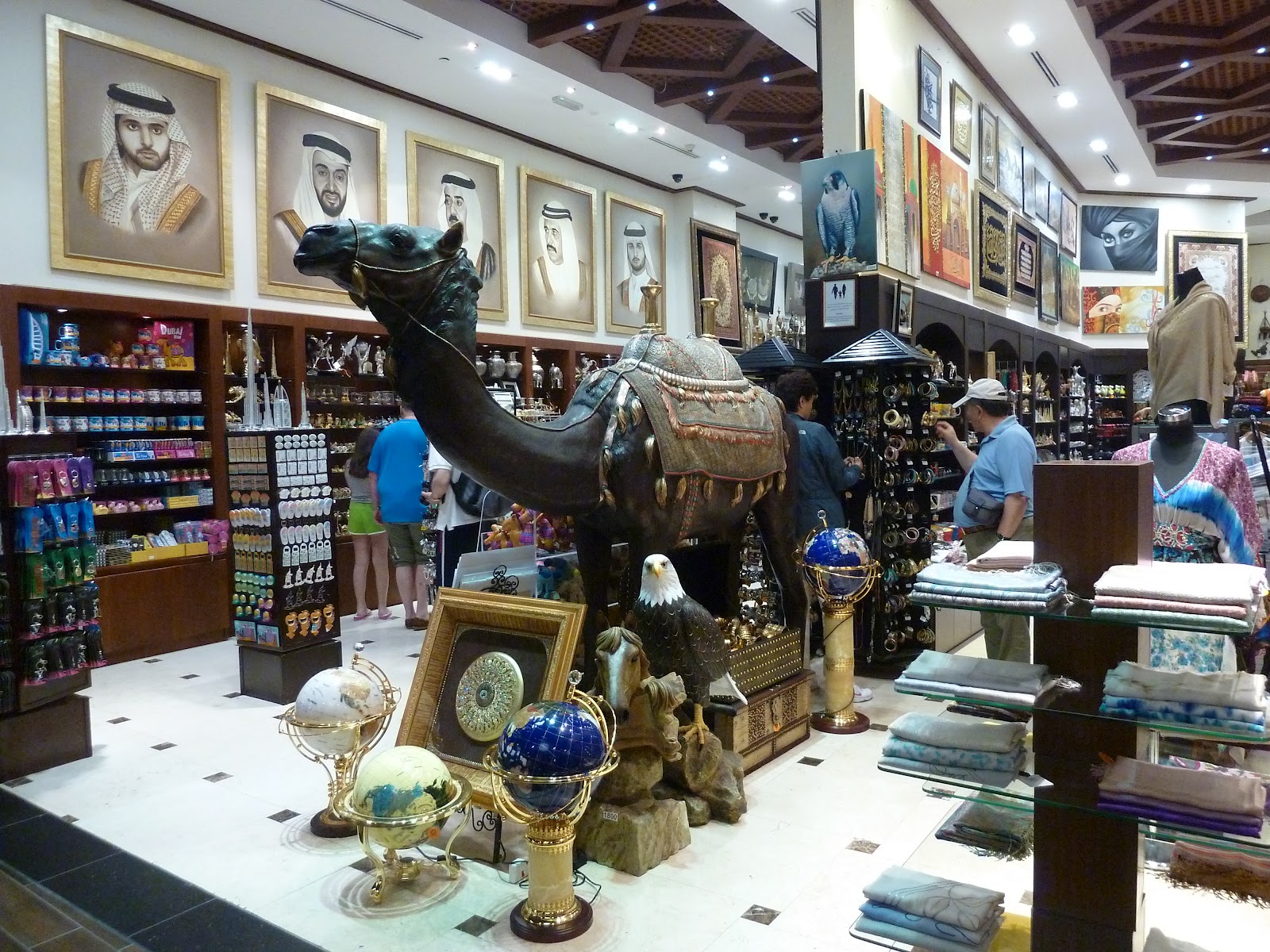

Dubai Mall, Curio Shop
It's not easy to get a stuffed camel aboard, but the live ones are two doors down!

With all our urge to shop gone, we trekked toward the shuttle bus in the noonday sun.  Taking our life in our hands, we crossed the street, entered the dust bowl parking lot, and boarded the bus for the trip back to port.  On return to the port, four (or more) additional cruise ships were docked, bow to stern.  There is a lot to be said for "build it and they will come."


The Silversea Shuttle
Cruise passengers' worst nightmare!


Cruise Ships, Port Rashid, Cruise Terminal
Which one is ours?

After lunch and a nap to recover from the "crowds" at the Dubai Mall, we played cards and went to tea.  At 10:30pm, we sailed for Khasab, Oman.


Mega Cruise Ship (Pacific Princess) Underway
Departing Port Rashid


Sunset Over the Arabian Gulf and Peninsula

Monday, July 23, 2012

Gao and Mumbai

Prepared July 22, 2012 at home Kona, Hawaii

April 6, 2012 at sea eastern Indian Ocean enroute to Mormugao, Goa, India:  So Many Lectures, So Little Time

Silver Whisper departed Kochi, India about 11:00pm and sailed northward up the coast of India.  It would be about a 30 hour cruise to Mormugao, the port for the Indian province of Goa, which was our next stop.

J & E used most of the day to complete and post the account of their overland trip to Dien Bien Phu and northwestern Vietnam.   This included using a hand-held portable scanner to scan maps of the little-visited region of northwestern Vietnam and of the battlefield.

Sea days are often enlivened with lectures by notable people, especially authors or academics whose disciplines are of interest to the literate, well maybe semi-literate, cruise audience.   On this cruise, lecturers had included James Bradley, "Flags of Our Fathers", and Bill Bryson, ""A Walk in the Woods", and numerous others.  Usually, J & E had forgone these lectures because they conflicted with bridge, but today two lectures were in the morning, while bridge was in the afternoon. Both lecturers were speaking on interesting topics.  Diana Preston was to speak on the sinking of the Lusitania, based on her book "Willful Murder? - The Sinking of the Lusitania," and Philip Hurst on modern India's geopolitics, "A Tiger with a Bomb: India Facing the Future."  The lectures normally last 45 minutes, are profusely illustrated, and keep one's attention, even in a darkened theater. (Well, for most guests anyway; on occasion, there can be heard light snoring.)  Lectures also can provide background knowledge for the area where we are cruising and going on shore tours, as Mr. Hurst's did on India. 

One additional aspect of the lecture program is that cruisers can invite the lecturers to lunch or dinner, and it gives you an opportunity to raise related topics and ask further questions.  All-in-all, it is a very positive aspect of the cruise experience, and on long cruises with numerous sea days provides for an interesting intellectual experience not often associated with the halcyon life of cruising.

We were again sailing in pirate waters.  All of the Indian Ocean  north of an east west line of latitude from the coast of Mozambique west south of Diego Garcia to the longitude  of Cape Comorin (Kanyakumari),  India is currently considered pirate waters, called the "Extended Risk Zone" by international maritime authorities.  (See Chart)  So even though sailing well within 200 miles of the Indian coast, the ship was blacked out and extra watches and security were in place.  It was, as a minimum, good training for the ship's crew, for the upcoming crossing of the northern Indian Ocean from Mumbai to the United Arab Emirates and on to Safaga, Egypt.


April 7, 2012 in port Mormugao, Goa, India:  India's Christian Enclave

We were docked at Mormugao by 8:00am, but both of us decided not to go on tour (we had been in Goa in 2009 and toured extensively), and the port area of Mormugao has very little to offer.  Mormugao is a major coal port -- need more be said.  We stayed on board and worked on the blog, read, and played cards.  E won again, and it was getting very tiresome for J.


Mormugao from Seaward


Self-Propelled Coal Barges, Mormugao, India

Focusing on the port city of Mormugao does not do justice to Goa.  Goa was a Portuguese colony from the 16th through most of the 20th Century and the Vatican of Asia during that time.  There are three major 16th Century cathedrals and other important historic sites related to Roman Christianity spread in Asia and Africa.  Also, there are the normal number of tourist beaches and resorts.   But not around the port!

N.B. -- If any of you desire to see images of the the catherdrals or the dead saints entombed there, let me know and I will add them to the blog.  They are from a earlier visit in 2009.

That evening, after sailing for Mumbai, the Captain hosted a special Asian dinner for World Cruise guests.  It was, of course, exceptional, adding even more weight to J's ever-expanding waistline and other body parts.  So you can appreciate the meal, we have scanned the menu, but no images.  J was too busy eating to take any pictures.


Captain's Asian Dinner Menu
All this on the last day of Lent, and near the most holy site in Asia!
Bacchus wins again!

When we returned to our room, we found that the Easter Bunny had visited, and we had received an Easter basket with E's annual chocolate rabbit.  Surprising new knowledge, Indian rabbits can swim and climb  aboard cruise ships.  Let's hope the pirates don't find out.  Actually, the basket was from the Officers and Crew of the Silver Whisper.


Easter Basket and Orchid
The Orchid was our "house plant;" it traveled most of the voyage with us.


April 8, 2012 in port Mumbai, India:  A Day at Chhatrapati Shivaji Maharaj Vastu Sangrahalaya


We were not participating in an organized tour of Mumbai and intended to spend the day at the Chhatrapati Shivaji Maharaj Vastu Sangrahalaya, formerly known as the Prince of Wales Western India Museum, and still normally referred to by its original English name (Prince of Wales Museum).  (Interestingly, the city's English name, "Bombay," seems to have been largely replaced in the local English vernacular by the new Indian name, "Mumbai."  But, it is easy to see why the Museum's new Indian name has not really caught on.)

We did not go ashore until about 10:00am, because the Museum was a short taxi ride from the pier, and we did not want to find ourselves outside a locked museum and the subject of unwanted attention by Mumbai's street people.  Walking up the pier, we passed the INS Viratt (R22) one of the Indian Navy's aircraft carriers.  (It was formerly the HMS Hermes.)  Then, we passed row-on-row of newly-imported Japanese and Korean trucks and buses until we reached Green Gate and the taxi stand.  Gone are the days of the yellow and black Ambassador taxis with their Sikh drivers who took you where they wanted to go.  In new Mumbai, the taxi is a new, clean Marrudi/Suzuki, with a driver who takes you to your requested destination at a prearranged price and even offers to return for you at your convenience.  See, change does happen.

After a short drive through the old Imperial Bombay section of Mumbai, best known to Western tourists for the Gate of India and the Taj Mahal Hotel, we arrived at the Museum to purchase our ticket.  In the long- cherished tradition of Indian bureaucracy, it was not "a" ticket but three tickets, and the lines were so complex that if it were not for the help of a retired Indian Army Sepoy (now museum guard), J & E likely would still be in line (probably the wrong one!).


Museum Tickets -- General Admission, Camera Pass, Audio Tour
Note:  Convenient string to attach Camera Pass to camera.  Provided WITH ticket!

The Museum is sited in a large garden near the Gate of India, and the garden (The Crescent) is still maintained as originally designed.  The building itself, designed by George Wittet, is considered a model of the Indo-Saracenic style of architecture typical of British India in the late 19th and early 20th Centuries.  At the core of the collection are the donations of Indian miniatures by Seth Mavji in 1915, the Major Art collections of Sirs Ratan Tata and Sir Dorab Tata, and the antiquities collection of Sir Akbar Haydari in the 1920s and '30s.  The Museum's collections contain over 50,000 pieces of art and artifacts.

Needless to say, we had to limit our viewing to a small number of even the items currently on display.  We chose those from the 42 items which were described in some detail in the Audio Guide.  Since J had his Camera Pass (with string), he was allowed to image some of the interior and art works.


Central Hall, Key Gallery


Hindu Statuary, Key Gallery


Ivory Box, Mughal Tradition, 1903

J & E spent most of their time in the Miniature Painting Gallery.  The Museum's collection of miniature paintings is one of the best we have ever seen.  It encompasses most of the Indian schools of miniature painting from the 14th to the early 19th Century, including numerous examples from the Sultanate and Mughal periods.  No imaging was allowed in this Gallery even if you had a chitty (with string).  But you can view some of the Museum's finest miniatures and other items at www.themuseummumbai.org.  The web site   also will give you access to many other galleries of the Museum's collection.


About three hours into viewing the collections, and long before we had finished the 42 Curator's Choice items on the audio tour, we were suffering severe museum fatigue,  Also, the Museum's main spaces are not air conditioned, so it was getting very hot.  A stop at the museum shop for J's de rigueur t-shirt (Gate of India with stamp), and we returned to our waiting taxi.    The taxi was both on time and in the place where the driver said it would be, so with a short drive by the Gate of India and the Taj (accompanied by numerous attempts to entice us to visit tourist shops), we returned to the port and Silver Whisper.  Then, it was lunch and a long nap.  Culture is very tiring.


Thursday, July 19, 2012

Across the Bay of Bengal and on to Cochin

Prepared July 16, 2012, at home Kona, Hawaii, USA


April 2 to April 4, 2012 at sea Bay of Bengal and eastern Indian Ocean:  Lazy Sea Days

After departing Penang Island, we cruised northwest up the Straits of Malacca and around the northern tip of Sumatra, then turned west southwest across the Bay of Bengal around the southern tip of Ceylon and into the western Indian Ocean.  Taking a northern course, we passed west of the southern tip of the Indian Peninsula (Cape Coromin) and reached Kochi, formerly known as Cochin after three days at sea.

During these longer at-sea passages, cruise passengers mainly focused on various on-board activities -- bridge, lectures, entertainment, and, of course, eating.  But, any type of unusual sighting at sea creates a great deal of interest.  These sighting events usually involve fauna (air- or seaborne) or other ships.  Both fauna and ships engender a great deal of speculation by the passengers.  Regretfully, on this cruise, we seemed to sight more unusual purpose-built ships than we did fauna.   So, there are no pictures of whales or albatrosses!


Oil Exploration Support Ship -- Bay of Bengal


On the evening of April 4, as we rounded Cape Coromin, Captain Corsaro, held an all-passenger security meeting to discuss precautions to minimize the threat of piracy while we were cruising in the Indian Ocean.  The major impact on passengers was the need to darken ship, thereby keeping the stateroom drapes closed from sunset to sunup.  Of course, the ship took other actions, but these were not discussed with the passengers.  However, the passengers spent a good deal of time and effort speculating on what they might or might not be.


April 5, 2012 in port Kochi (Cochin), Kerala, India:  Welcome to the New India -- Watch Out for the Goat!

Silver Whisper docked at the cruise ship terminal on Willingdon Island about 9:00am.  Since this was our third visit to Kochi in the last six years, we did not really want to return to the same tourist spots.  Instead, we hired a private car to take us to the Le Meridian Hotel in the Kundannoor District of Kochi to make other Starwood hotel reservations.  We did not leave the ship immediately, but waited for the ship's tours to set off before disembarking.  J & E are not fond of queues, especially consisting of cruise passengers in a hurry to get to the front seat on the tour bus.


Tour Buses at the Ready, Kochi Port

Our driver/guide met us on the pier with a new white Toyota, and we were off through the port area, over the causeway and into the streets of Kochi to the hotel.   Kochi's metropolitan population is approximately 2 million, and the city seems to be built around innumerable water features.  This is a nice way of saying that the city is situated in a very large coastal swamp.  However, the traffic wasn't impossible, so we accomplished our mission at the Le Meridian very quickly and had a tea in the hotel's lounge, while the hotel manager confirmed reservations.

The minimum car hire was for four hours, so our driver/guide suggested that we see some sites that we had not visited earlier.  Since he was a Roman Catholic, our tour was an introduction to the history of Christianity in southern India.  Our first stop was St. Francis C.S.I. church in Fort Kochi.


St. Francis C.S.I. Church, Fort Kochi, Kochi, Kerala, India

St. Francis (originally St. Bartholome) is the oldest European church in India, and
Fort Kochi is the oldest European settlement, established by the Portuguese in 1503.

St. Francis has served the denomination of the imperial power of the moment.  It has been Roman Catholic, Dutch Reform, Anglican, and is currently Church of Southern India (C.S.I.).  The building dates to 1779, but it has been rebuilt and renovated many times.


Interior, St. Francis C.S. I.


Altar, St. Francis C.S.I.


Baptismal Font, St. Francis C.S.I.

There are numerous tombs inside the church and on the church grounds.  The church grounds include the Dutch Cemetery that records Dutch possession of Kochi for 200 years until it ended in 1795 when Kochi became a British possession.  Probably the most famous person  originally buried in the church was the Portuguese explorer, Vasco da Gama, European discoverer of the sea route to India.  He died at Kochi in 1524, on Christmas eve, of malaria and was buried in the church until his remains were repatriated to Portugal in 1539.    His gravestone is part of the interior floor of the church.


Vasco da Gama's Gravestone, St. Francis C.S.I


To preserve the early gravestones of other Portuguese and Dutch imperial functionaries, they now line the interior walls of the church, with the Portuguese notables' gravestones along the north wall of the church, and the Dutch on the south wall.  We guessed that the more recent occupants of the church did not want the Catholic and Protestant spirits to have an opportunity to squabble over theology, so they separated them.


Portuguese (North Wall) and Dutch (South Wall) Gravestones, St. Francis C.S.I.

From the church, we were driven to the park at the tip of Fort Kochi.  Our guide wanted to show us the Chinese Fishing Nets.  The local story is that when the Portuguese saw the Chinese in Macao using these nets, they brought the design to Kochi and built the nets along the coast near the fort.  Will the theft of intellectual property never cease!

The fish nets work using the balanced fulcrum principle, like a teeter totter, with the seaward nets balanced by landward stones.  There were probably many more in the past, but now there are about 6 in the immediate Fort Kochi Park area, which seem to provide some fresh fish, but more entertainment for visitors to the park.


Chinese Fishing Nets


Catching Fish -- It Really Works!
Fish in bottom of center net.


Fresh Fish Anyone?

Fort Kochi, and the surrounding area, is also a free range zoo, typical of Indian settlements from village to  mega cities.  The Fort Kochi peninsula seemed to specialize in goats, who spent most of their time caging food from tourists.  But there was no shortage of other beasts ranging about.


"Got a Hershey Bar?  I'm Tired of Coconuts."

The Fort Kochi area has many 17th, 18th and 19th Century Residences built by the Portuguese, Dutch and the Raj, during their 450 year sojourn in southern India.  Many of those buildings are architecturally interesting, and a number of them have been preserved by converting them to boutique hotels or guest houses for tourist.


Dutch Trader's Residence Converted to Boutique Hotel
(Note the restored Ambassador parked in front.  Who would of thought! )


The Splendor of the Raj.  It is Good to be the Raj.

As we were leaving Fort Kochi, we saw the return to port of an Indian Navy patrol ship.  Kochi is a major Indian naval base, and headquarters for the Indian navy's Indian Ocean Fleet.  It was reported while we were in India that an Indian naval unit had engaged a pirate vessel and sunk it. Seems that the Indian navy learned law of the sea from the old Royal Navy, not the U.S. Navy and NATO, who are too busy filling out forms and consulting lawyers to deal directly with treats to freedom of the sea.  Maybe the USN could engage the pirates with paperwork and lawyers and bore them to death!


Indian Navy INS Sharada (P55) Returning to Port

Our tour's next stop was the Santa Cruz Basilica, the seat of the Roman Catholic Bishop of Alleppey, part of the city of Kochi.  Regretfully, there was a diocese conference underway, and the Basilica was closed to tourists.


Santa Cruz Basilica

Our next stop was the residence of the Bishop of Alleppey, which dates in part to the 1500s.  Although the residence is off limits to the general public, the grounds are not.  The grounds of the residence where used as a botanical garden by the Portuguese, so many interesting and economically important species can be found among the plantings.


Bishop of Alleppey's Residence
(If you can't be the Raj, maybe try Bishop)


Pepper Tree
(This may or may not be pepper.  J didn't make notes.)

After visiting the Bishop's garden, it was back to the Silver Whisper and lunch on the pool deck, then a nap and a lazy afternoon of reading and playing "Spite and Malice."  Eloise won, as usual.

Before dinner, the Cruise Director, Fernando, arranged for a dance troop from the local Katakali school to perform.  Katakali, or "story play," is a form of folk dance that evolved from earlier Sanskrit dances  originally associated with Hindu temples.  These dances are now known only in Southern India, which did not suffer the tender mercies of Islamic (Mogul) invasion.

Katakali dance takes the form of a drama, think opera, with the content delivered in face and hand expression, masks and colorful costumes which define the characters.  The dramas seem to concentrate on four universal themes -- love, death, truth, and power.   Many of the plays have their origins in the Ramayana. From the western audience's perspective, the makeup, masks and costumes, are truly spectacular.  If you are interested in the Katakali dances go to this web site www.kathakalischool.com.


Katakali Dancer in Costume


 Elaborate Dance Costume


Kathakali Dancers Presenting Play
(Regretfully, No English Captions)


Curtain Call, Everyone Namastes

After a much edited and shortened one-hour performance (Westerners' attention span is not up to four and five-hour dance performances, no matter how colorful the costumes or loud the music), we left the theater and returned to our suite to watch a movie.  At 10:30pm, we sailed for Mormugao, India, the port for Goa.

Sunday, May 20, 2012

Shadows of the Pukka Sahib


Prepared May 20, 2012, at home Kona, Hawaii, USA


April 1, 2012 in port Penang, Malaysia:  Tea at the E & O


In the early morning of April 1, Silver Whisper entered the South Channel between Penang and the Malay Pennisula  and began to maneuver and dock at Swettenham Pier on Penang Island.  By 8:00am, the ship was tied up and cleared to disembark.


Butterworth Container Port and Local Junk from South Channel

Penang was the British Empire's original toehold in Southeast Asia, and along with Singapore, it made up the Straits Settlements.  Although it is now overshadowed by Singapore as a trading and shipping center, it is still the major port at the northern entrance to the Straits of Malacca.  Penang Island  and a small area across South Channel on the Malay peninsula make up the province of Penang.  It feels more Chinese than Malay and is, in fact, the only Malaysian province with a Chinese majority.


Since we had been in Penang before (the most recent time in 2010), we decided not to go ashore on a tour or walkabout.   A leisurely morning was spent on board the ship, and after lunch, we left the ship to join other world cruise passengers for a World Cruise event  -- Tea at the Eastern & Oriental Hotel in George Town.  The Eastern & Oriental Hotel dates from the 1880s and was established by the Sarkies brothers who, based on the E&O's success, opened the now much more widely known Raffles hotel in 1887 at Singapore two years after the E&O.  Like the Raffles in Singapore and the Peace in Shanghai, staying at the E&O on your grand tour east of Suez was de rigueur.  So, the guest book is full of the late 19th and 20th century social and political elites.  To drop a few names Rudyard Kipling, Somerset Maugham, Sun Yat-sen, Charlie Chaplin, Sir Noël Coward, Douglas Fairbanks, Hermann Hesse, and Lee Kuan Yew.


Eastern & Orient Hotel Street View


Eastern & Orient Hotel Oceanside View


For the short ride from the Swettenham Pier to the E&O Hotel, we were put on trishaws and sent out into the afternoon traffic of George Town.  It was a real thrill to see Honda and Toyota turning lights at eye level.  Being pedaled through the streets by a Tamil who appears to be less than a week from his next incarnation, makes a good case for cruelty-to-humans laws stronger.  Think tuberculosis and smoking!  The short trip was made in convoy with about 25 other trishaws containing other world cruisers.  It was a scene that could only be described as bazaar!  Two non-Asians in a trishaw is an overload,  two world cruisers in a trishaw after months of overindulgence onboard ship is way beyond overload.  Anyway, after passing under the guns of Fort Cornwallis, and by the offices/go-downs of the trading companies, and many banks, we arrived, sans car grill emblems on our bodies, at the E&O Hotel and were escorted by the staff and with drumming to a large banquet room.  (In earlier times, guests might have wondered if he or she was going to be served!)


All Aboard the Trishaw
E picked this one because she liked the flowers (plastic)


Trishaw on the Road
Note convertible top - down in this Image


George Town Clock Tower Roundabout


George Town City Hall (Part)


George Town Police Station


Reception Line at E&O Hotel

The tea was a testimony to why traveling in large groups can lead to food poisoning.  Tea was poured from large (~5 gallon) samovars that gave forth very weak tea, while the scones could have been used as weapons in a street riot.  Think of the E&O's tea as tourist bus "rest stop" offerings.  The good news is that all of us seemed to survive the experience with no ill effects.   Unknown to us, the "tea" included another cultural show with Chinese, Malay and Indian dancing accompanied by canned music played on a hyperactive sound system.  One advantage my fellow passengers with hearing aids have in a situation like this is that they can just turn them off!  Unfortunately, some had to suffer.  Gamalong and gongs at 90db are not for the weak of heart.  But, this too was survived.


Let the Culture Begin
Malay, Chinese and Indian hybrid dance. 

After free time, mostly in the hotel's gift shop, it was onto a tourist bus for the 10 minute ride back to the pier.  After re-embarking, we had a late afternoon sailing and a course set to cross the Bay of Bengal, around the tip of India, and on to Cochin, India.


About a half hour out of Penang, the Captain announced that the executive chef, Jean Marie, had acquired an exceptionally large fish to be served at dinner.   If any of us wanted to see it before it was carved, it was on the pool deck.  Of course, armed with a myriad of the latest in digital camera technology, the passengers rushed to the pool deck to photograph the fish.


April Fools!!!


Wednesday, May 9, 2012

Thailand and Through the Straits of Malacca


Prepared April 23 and 24, 2012, Gulf of Aqaba and Aqaba, Jordan and Sharm el Sheikh, Egypt
  
March 28, 2012 anchored off Ko Samui, Thailand:  A Day in the Sun or Not

After an overnight cruise from Bangkok, we anchored at mid-morning in the Bay of Thailand off the small island of Ko Samui where we were joined by the M/V Europa.  Unless you wanted to lay on the beach or snorkel, it was a port visit without much to visit.  (When the local shopping guide's main item to purchase is pirated copies of Western CDs and DVDs, you know you are in trouble.)  Except for some Buddhist temples and a few tame elephants to ride, there just wasn't much to do. These were not an  attractive set of options to J and E, and coupled with the long run into shore on the ship's tender (in rather choppy water), we voted to sleep late, stay on board working on the blog, and reading.  About 6:00pm, we uped anchor and sailed for Port Klang, Malaysia.


Oh Great!  Now Two Cruise Ships' Passengers Looking for Something To Do
M/V Europa, Hanseatic Line


Thai Long-Tailed Fishing Boat Off Ko Samui

In fact, we were in such a low activity mode, we did not go to dinner in the dining room, because we would have had to dress formal, but went to the La Terrazza, the ship's Italian restaurant.  (J still had to wear a suit, which he claims has shrunk in the closet since the beginning of the trip.)  However, the formal gods struck back and gave J a night of communing with the commode.  Not a cruise experience to be recommended!


March 29 and 30, 2012 en route to Port Klang, Malaysia:  Here a Ship, There a Ship, Everywhere a Ship!

Our course, through the South China Sea, around Singapore, and into the Straits of Malacca, took us through some of the most heavily-trafficked sea lanes in the world.  Since we had little to do but play bridge and listen to excellent lectures by guest speakers, J photographed passing ships and created a mosaic that would give an idea of the variety of ships and their density in these sea lanes.  All of the photos were taken within the daylight periods on 29 and 30 March as we passed near Singapore and entered the Straits of Malacca.


Shipping Off Singapore

The ship's doctor, hearing via the ship's ever-active rumour mill of J's upset stomach, asked J to come in for a consultation with him.  The doctor pronounced that J had a case of gastritis (caused by hyperactive acid glands) and gave him some anti-acids, and sent him on his way.  Actually, the condition had passed by this time, but the long-term effect was that J was more prone to missing meals and less prone to over eating.  Sadly, it did not help the suit problem. 

On the evening of March 30, we had dinner with Fernando, the cruise director, and 7 other guests.  Dinner with Fernando in The Restuarant is always a great evening, because Fernando is a skilled raconteur and has many stories of his 30-plus years at sea on cruise ships.  He is also a diplomat and keeps even the most potentially hostile guest in a non-combative mood.


March 31, 2012 in port Port Klang, Malaysia:  A Birthday Party

Docking at Port Klang at 8:00am, we decided to sleep in, have a late breakfast, and stay on board.  Kuala Lumpur is a 30-minute shuttle bus ride from Port Klang, and we decided a bus trip was not in the cards.  Besides, we have visited KL several times and could not think of a single reason to suffer 60 minutes+ on a shuttle bus.  Picky, Picky.  We spent the day reading, working on the blog, chatting with friends, and generally lazying about.  We did bestir ourselves to the point of attending an excellent classical piano concert in the early evening.


Tug Along Side, Port Klang, Malaysia


Tied Up, Port Klang Cruise Terminal

At 7:30pm, we were off to a cocktail party (more club soda) and dinner to celebrate our bridge friends' (John and Pinky) birthdays.  It was all-in-all an entertaining evening at a table for 12 in the dining room.   Dinner and conversation continued into the late evening and we did not return to our room until about 11:00pm.  As a famous diarist said, "and so to bed."