Thursday, September 20, 2012

On to Egypt -- Land of Mummies and Martyrs


Prepared September 16, 2012 at home Kona, Hawaii


April 16 to 20 at Sea:  Gulf of Oman, Arabian Sea, Gulf of Aden and Red Sea.


M/V Silver Whisper departed the port of Muscat at 5:00pm local time on April 15 and set course for the Red Sea port of Safaga, Egypt.  This was five and one-half days of sailing near the coasts of eight countries none of which, with the possible exception of Saudi Arabia and Oman, were more than two arms dealers away from an uprising of some sort.  So, it was full nighttime security, and a high level of novel rumors.

Destination Safaga, Egypt


Since Joann and Danny, our favorite bridge instructors, had left the cruise in Singapore, and we had been off-ship in Viet Nam, our bridge playing skills were rapidly atrophying.  We saw little hope of them ever improving (old dog, new tricks -- that sort of thing); therefore, we decided to attend the ship's enrichment lectures instead of providing the dog's tail for contract bridge.   The lectures that were of particular interest to us were on ancient Egypt and were presented by Prof. Bob Brier and Patricia Remler over the five sea days.  They covered numerous topics of archaeology and ancient history, including mummification, Egyptian historiography, Tutankhamen, Hatshepsut, the temples of Karnak and Luxor, Egyptian mythology, the Great Pyramid, Cleopatra, and Napoleon in Egypt.  All-in-all, a good introduction to Ancient Egypt.

April 21 and 22 in port  Safaga, Egypt:  Welcome, First Tourist of 2012!

We docked in Safaga at 7:00am, and the vast majority of passengers departed by bus for an overnight tour of the Karnak/Luxor temples and the Valley of the Kings.  J and E decided that two,150-mile bus rides through the Eastern Egyptian desert to see heavily-touristed attractions (which  we had already seen several times) were not in the cards for this trip.  So, we stayed on board in Safaga.

The port of Safaga's main purpose is to allow Egyptian workers and pilgrims access to Saudi Arabia.  Everyday, two or more large ferries depart and arrive from the Saudi port of Jeddah.  


Ferry Across the Red Sea
Safaga/Jeddah ferry embarking passengers and cargo.

The previous Egyptian government had made some attempt to develop tourist facilities at Safaga, and Silversea provided a shuttle bus for the 15-minute trip from the port to the tourist area.  J and E decided to take the shuttle bus (15 minutes is just tolerable) to the Riviera Abu Soma Hotel in the tourist zone, so E could buy a dress for the upcoming Arab dress night.  Armed with a locally-produced tourist map, we stepped off the bus and found we were in the middle of a ghost town with only our few fellow passengers to be seen and even fewer Egyptians.  There was no need for the tourist map -- only a single paved street.


Welcome to Safaga
Be very careful crossing the street!

The economic impact of the Arab Spring was obvious from empty hotels and streets and abandoned construction sites.  The price of freedom, as so many have found, is often starvation.  Numerous gift, curio and tourist-activity related shops were open, but almost everything was covered with a coat of fine sand.  Nothing was happening here.


This Is NOT the Entrance to Tut's Tomb
Papyrus painting of Tutankhamen's gold funerary mask on local shop door

We looked in several shops and finally found a dress shop where E purchased a local-style dress -- mumu with excessive, fancy embroidery. The dress selection process took about 45 minutes, with the display of at least 30 different dresses!  J's haggling over the price then took another 30 minutes, with two near departures from the store.  The merchant still won, but J only overpaid by half again!  Some sort of victory.  And, given the state of the local economy, we didn't feel too put upon.

After the purchase, we finished our promenade, carefully crossed the street, and returned to the hotel lobby, which was our collecting point for the shuttle bus back to the port.  The rest of the day was spent eating, writing the blog, and visiting with others who didn't go to Luxor.  That evening was a special buffet in the Terrazza.

Next day in port we spent on board, and after the return of those passengers from their tour to the Nile valley, we sailed for Aqaba, Jordan.


Goodbye Safaga!
Sunset over Safaga and the Eastern Desert.

April 23 in port Aqaba, Jordan:  "On to Aqaba"

We docked at the port of Aqaba, Jordan at 7:30am.  Most of the passengers disembarked for a long day of bus trips to visit the Nabatean city of Petra about 60 miles north of Aqaba, or to Wadi Rum.  We decided that since we had been to Petra and were not terribly interested in a large sand pile surrounded by cliffs, we would stay in Aqaba and visit the Aqaba museum in the Mamluk (Turkish) fort.  After the battle of Aqaba (July 6, 1917), this fort was surrendered by the Turks to Auda ibn Tayi, T. E. Lawrence, and Emir Faisal's Arab army.  Aqaba then became a major British supply base for Faisal's campaign against the Turks in Arabia and Palestine. 

A historical side note:  During the fighting around Aqaba,  Col. T. E. Lawrence, while involved in an assault on Turkish troops, shot his own camel in the head and killed it.  Luckily, the camel did not fall on him and he was unhurt.  I don't think this was in the Victoria Cross commendation or the movie, "Lawrence of Arabia."


Aqaba is located at the northern end of the Gulf of Aqaba.  Four Middle Eastern countries converge at this point -- Egypt, Israel, Jordan, and Saudi Arabia.  From our ship's observation lounge, you can see all four countries.

After breakfast, we took the shuttle bus into the Tourist Information Center, collected directions and a map to the fort (known locally as the Aqaba Castle or Mamluk Fort), and had a leisurely walk along an embankment above the park which borders the shore line.


Aqaba Shorline Park
The park is oasis-like, with paddy rice and date palms.

We also saw one of the few remaining early Turkish-period stone buildings, which were probably merchant houses and godowns close to the port.


Pre-WWI Turkish Merchant's House
Aqaba was a focus for trade between the Middle East and the Orient.


Mamluk Fort, Landward Entrance (Partially Restored)
During the Battle of Aqaba, not a great deal of fighting occurred here.
The garrison surrendered with little resistance.


Seaward Entrance, Built by British During WWI
Eloise playing honor guard.


British Built Supply Depot w/ Mumluk Fort in Background
Museum exhibits were on right and offices, etc. on left. 

After about 30-minutes walking, we reached the fort/museum, purchased Admission Tickets, and began to wander around viewing the exhibits.  Parts of the Mumluk Fort date to the 12th Century, when a fort was originally built on the site by the Crusaders.  It was rebuilt as it now appears in the 14th Century by the Mumluk's and added onto by the British, when it became a supply depot during WWI.  


The Official Admission Ticket
It only took about 15 minutes to find someone to sell us one.

The Aqaba area has been inhabited since pre-historic times, and the exhibits in the museum draw heavily on materials collected from archaeological expeditions to the area.


Artifacts from Archaeological Digs
The plate and pottery shards on the right are Chinese Celadon from the Yuan Dynasty.


Roman Altar 1st Century BCE
Yes, that unruly crowd in their short skirts were here, too!

After viewing the exhibits, which are mainly housed in the British-built part of the fort, we walked over to the Mumluk fort portion of the museum and were admitted by a young man, who volunteered to show us "some interesting stuff."  He took us through the fort's entrance to see the courtyard with the well and into the death chamber, where Turks tortured and hung Arab revolutionaries.  Also, up some very problematic stairs to the rampart positions.  By the time he had finished his tour, there were about six of us.  To this day, we don't know if he worked for the museum or was just free lancing for tips.   He got one from us.


Mumluk Fort Entrance
The white plastic chair will be an artifact in 3,000CE.


Guard Post in Entrance Hall
A small example of Arabic calligraphy on the hall's walls.


Exterior of Prison Cells
Many went in, few came out.


Interior View, Fortress Courtyard and Walls


Remnant of  the Hanging Post 
Interior of room where prisoners where tortured and hanged.


Rifleman's (Archers?) Firing Slot on Rampart
This is in a very early section of the wall.

After leaving the fort, we started to walk back to the Tourist Information Center along the main street.  We again passed the Al-Sharif Al-Hussein bin Ali Mosque, dedicated to the grandfather of the current King of Jordan.  It is a very pleasing structure to look at, and we had intended to visit it on our return from the fort.  However; because a service was being conducted in the Mosque, non-believers were not allowed on the grounds, so we had to forego touring the gardens and the mosque itself. 


Al-Sharif Al-Hussein bin Ali Mosque
The white walls and dome almost sparkle in the bright sunlight.


Minaret, Al-Sharif Al-Hussein bin Ali Mosque
No one climbs up there.  It is all electronic with big speakers.

Returning to the Tourist Information Center, we found the Silversea shuttle bus and boarded it to wait in air-conditioned comfort for the short trip back to the port.

After a lunch on deck at the pool grill (J got his weekly cheeseburger), we had a long afternoon nap, played cards (Eloise won, as usual!), we sailed down the Gulf of Aqaba for Sharm El Sheik, Egypt.


April 24 in port Sharm el Sheikh, Egypt:  "Where Have All the Tourists Gone?"

Silver Whisper docked at 6:00am in the port of Sharm el Sheikh.  J & E slept through this momentous event, but the more bright-eyed, bushy-tailed, religiously-driven cruisers were already on the pier at 6:30am for the 3-hour (150 miles), one-way, mother-of-all-tour-bus rides to Mt. Sinai and St. Catherine's Monastery in the middle of the Sinai Peninsula (see map).

We had made this pilgrimage once.  Since we had no desire to climb Mt. Sinai on our knees, visit the site and living plant of the burning bush, or again see the fortress monastery built by the Roman Emperors Constantine and Justinian for twenty minutes (hurry, hurry or you will miss the bus back to ship), we decided to stay aboard, have a leisurely breakfast, and take a late-morning shuttle to Na'ama Bay.


Welcome to Sharm el-Sheikh
First person to see any living vegetation wins a prize.

Sharm el-Sheikh is one of those sand, sun, and water places you might find in South Florida or the Mexican Riviera.  You expect those tourist destinations to be full of obscenely-behaving college students, loud music, and bad food.  All the infrastructure for Western-style tourism is here in Sharm el-Sheikh, including the usual suspects, Hilton, Marriott, Hyatt Regency, ad infinitum.  This was intended to be a destination resort on the Waikiki scale.  There was only one problem, no tourists.  On the 1-mile, shuttle-bus ride into town, you could count the cars on the road on your fingers.  When we arrived at the pedestrian street in Na'ama Bay, there were just large numbers of small tourist shop owners, and the 20 or so of us from the ship (shop owners out-numbered tourists by about 20 to 1).  Sometimes the "build it and they will come" theory of development does not work out so well!  Of course, this tourism disaster was at least partly the result of the Arab Spring and the fall of the Mubarak regime, but one drive through the area and it screamed "over developed."


Na'ama Bay Pedestrian Street
It's hard to run a sun and sea resort without drunken college students!


Greetings from the Pharaoh
Tacky copies of ancient Egyptian artifacts are everywhere.

We walked down the promenade looking in the shops and finding the same endless Egyptian stuff that you see everywhere in Egypt.  One of our friends, Max, bought a fez, and J bought some lose herbal tea, but there was nothing much being sold.


Our Friend, Max, Buys A Fez
Fezzes are rarely seen in the Middle East these days.  They have been replaced by AK-47s.

A Herd of Stuffed Camels and Bedouin Drums
A stuffed camel herd is the best kind -- don't eat, spit, or bite.


Spice and Tea Shop, Loose Bedouin Tea in Center
J's Bedouin tea purchase was lost on the trip back to the ship.  Probably just as well.

After passing an hour or so walking along the promenade and in and out of the tourist shops, we headed back for the return trip to the port.  When we got to the bus, several of us asked the driver/guide if we could see Mubarak's estate (where he was interned at the time).  He was very reluctant and evaded the issue.  We never got to see the only really interesting thing in Sharm el-Sheikh!


The Gods of Egypt Bid You Farewell to Sharm el-Sheikh
Good thing the ancient Egyptians had many gods.  What would the modern Egyptians sell?

So, we returned to the port, with the bus driver pointing out the International Peace Park and two casinos along the way.  Back on board, we had lunch (never miss a meal!), naps, and played cards until sail-away at 3:00pm.  An early departure was required for us to be in position at Suez (the southern entrance to the Suez Canal) for our north-bound convoy, which was transiting the Canal the next day.


Sunday, August 26, 2012

Oman - The Other Part of Arabia


Prepared August 24, 2012 at home Kona, Hawaii


April 14 in port Khasab, Oman:  Why Are We Here Exactly?


Map of Oman and Arabian Peninsula 
Not easy to find a map with Khasab--practice your German

We sailed from Dubai at 10:30pm the night of April 13.  That evening, before we sailed from Dubai, for the first time in 14 years of cruising with Silversea, J & E (along with ALL previously-embarked passengers) were required to participate in the embarkation life boat drill.  Prior to the grounding of the Costa Concordia, only embarking passengers participated in the drill.  Embarked passengers could if they wanted to but nobody did.

Silver Whisper docked at Khasab, Oman at 8:00am the next morning.  Khasab is an Omani exclave (geographer's word) on the Arabian Gulf that includes the Arabian Peninsula fronting western approaches to the Strait of Hormuz.  The following description from Wikipedia will probably provide you more information than you need about the Norway of Arabia!


Khasab (Arabic: خصب‎) is a city in an exclave of Oman. It is the local capital of the Musandam peninsula. Khasab is located 500 kilometers (310 mi) from Muscat and is dubbed the "Norway of Arabia".[1][2][3][4] The Portuguese built Khasab at the beginning of the 17th century at the height of their naval presence in the region. The natural harbor gave shelter from tough seas. Unlike many forts, which were built on high ground for defensive purposes, Khasab was designed as a supply point for dates and water for Portuguese ships sailing through the strait. Today, Khasab is protected from floods by three large dams.[5]

Access to the area by land was virtually impossible until a modern coast road was built, which allows fast access from the United Arab Emirates, making Khasab a popular weekend destination for people living in the Emirates. The new road also allows access to the village of Tawi, where prehistoric drawings of boats, animals and warriors can be seen in the rock face.[5] Khasab also has a number of modern shopping areas with imported Irani goods and locally created pottery, and a few hotels, including the Khasab Hotel and Golden Tulip Hotel, which sits on a cliff overlooking the gulf.[4]
Khasab has an interesting trading position, which hinges on its proximity to Iran. Iranians import sheep and goats into the local port, from where the animals are dispatched to the United Arab Emirates and Saudi Arabia in trucks. On their return trip to the Islamic Republic, the sailors load their boats up with electronic goods and American cigarettes, arriving in Khasab after sunrise and leave before sunset to conform with Omani immigration laws. Since the trading is illegal under Iranian law, they must avoid the Islamic Republic's coastguard as well as all other shipping in the busy waters of the Strait of Hormuz. The crossing is hazardous since the vessels, piled high either with livestock or with numerous boxes must avoid the path of the scores of oil-tankers which pass through the Strait in a transverse direction daily.[5] Recent increases of United States sanctions against Iran have increased the amount of smuggling done through Khasab.[6]

The Airport of Khasab, located few miles inland from the coast, on 27 June 2011, recorded the world calendar day highest minimum temperature of 41.2°C (106.2°F) until Death Valley, California broke the record by 0.5°C (about 1°F) on July 12, 2012.[7][8]

After the excitement of Dubai and the lack of a local horizon due to blowing sand, J & E decided that a trip to the souk to inspect illegal Iranian trade goods was not a high priority for either of us.  We had already seen Iranian-bound dhows stuffed and stacked to the gills with forbidden fruit at Port Rashid, Dubai.  (The port authorities of Dubai all have small, three-monkeys patch on their uniforms.)  Also, we were not keen to visit Bassa beach, especially with the warning -- "swimming  is at your own risk." So you will be spared amateur images of Khasab and Bassa beach just as we were spared another five-mile ride on a Silversea shuttle bus.  If you are heartbroken about the lack of images, google Khasab and Bassa beach on the web; there are numerous ones there.

At 4:00pm we sailed for Muscat, Oman and shortly thereafter, the Captain held an all-hands security briefing.  We were returning to the developing world of the Indian Ocean, Arabian Sea, and Gulf of Aden, where the local entrepreneurs are called Somali pirates and don't work for Bain Capital (or maybe they do)!  We were each provided with a two-page letter of instruction concerning our transit through the Suez Canal in the Internationally Recommended Transit Corridor (IRTC).  It gave us great confidence to know that a total of four different agencies were overseeing our safety -- the MSCHOA, UKMTO, EUNAVFOR, and MARLO.  We were probably fortunate that they could not speak the same language or they might have got in each others' way!  It looks like their major weapons system deployed against the pirates was the strong letter in multiple copies!  As they say, entrepreneurs create jobs.
After the lecture and many assurances of our complete safety, we went to dinner in the La Terrazza and soothed our nerves with an excellent Italian meal.  Now, there is something they really do well on Silversea!  In the late evening, we started our transit of the Straits of Hormuz.  We hoped that the Iranian Navy and whoever else was armed and dangerous in the area were sleeping off the smuggled wine they had acquired in Khasab!


April 15, 2012 in port Muscat, Sultanate of Oman:  Arabia at Its Best!

After the overdone glitz of Dubai and the barren desert of Khasab, it was a pleasure to make port in Muscat.  Muscat has long been J & E's favorite port in Arabia.  The desert mountains surrounding the bay, the old Portuguese and Omani fortresses that loom above the bright white traditional architecture of the city, provide visual impact that is not soon forgotten.


Muscat, Oman
The Mutrah corniche with the souk in the center of the frame behind the dhow.

Thanks to the leadership and tastes of the Sultan of Oman (Qaboos bin Said Al Said), the 71 year old ruler and the 14th generation descendant of the founder of the Said Al Said dynasty, Muscat has not succumbed to the sterile and banal western urban architecture that typifies most of Arabian Gulf cities.  Much of Muscat's modern construction was forced by the Sultan to adhere to the traditions of Arabic architecture; therefore, one experiences a much greater exposure to the culture and history of Arabia and Oman.


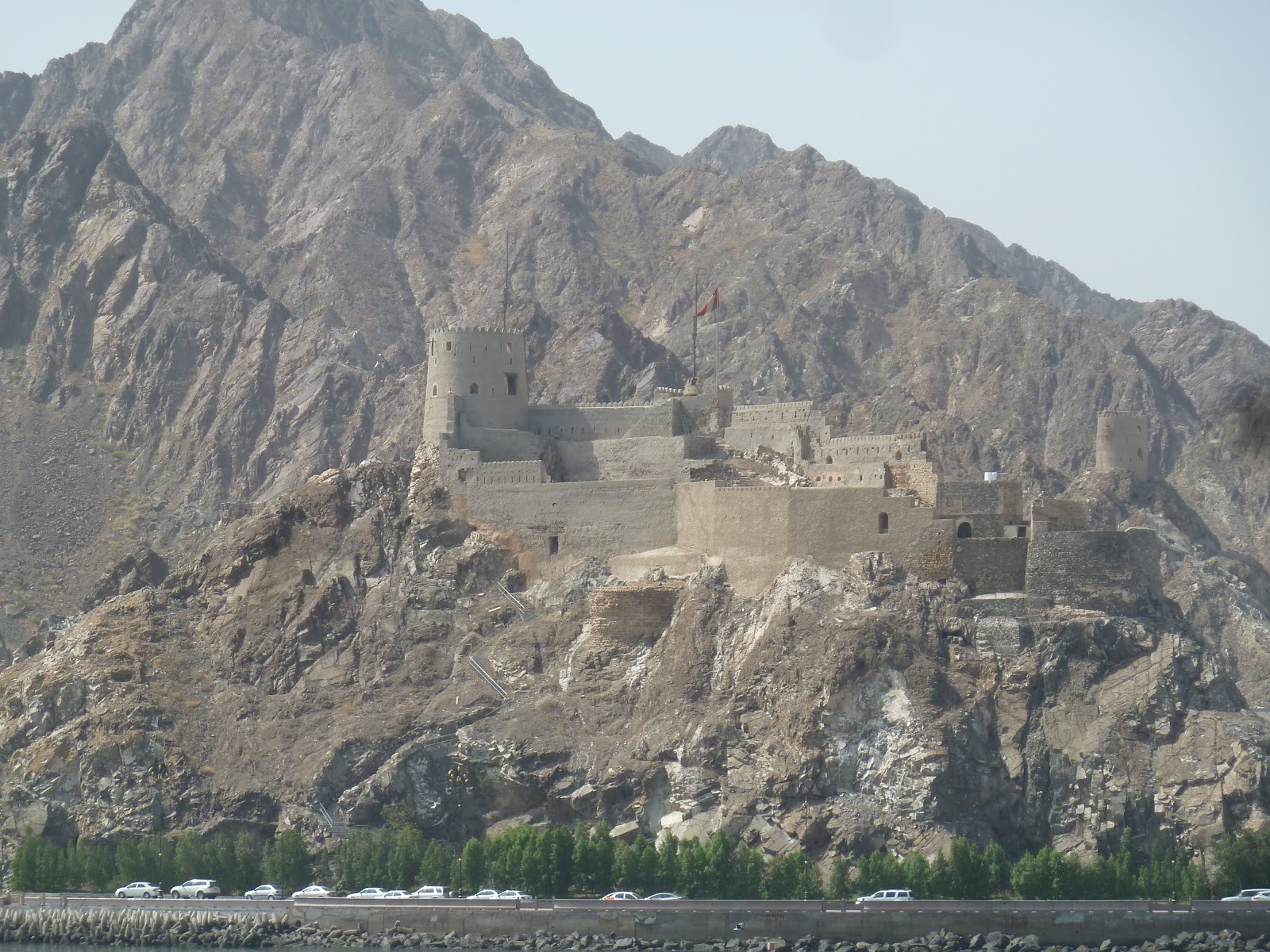
Portuguese-Built Fortress Overlooking Muscat
From Muscat, the Omani's empire extended around the Indian Ocean to modern Pakistan and Zanzibar.

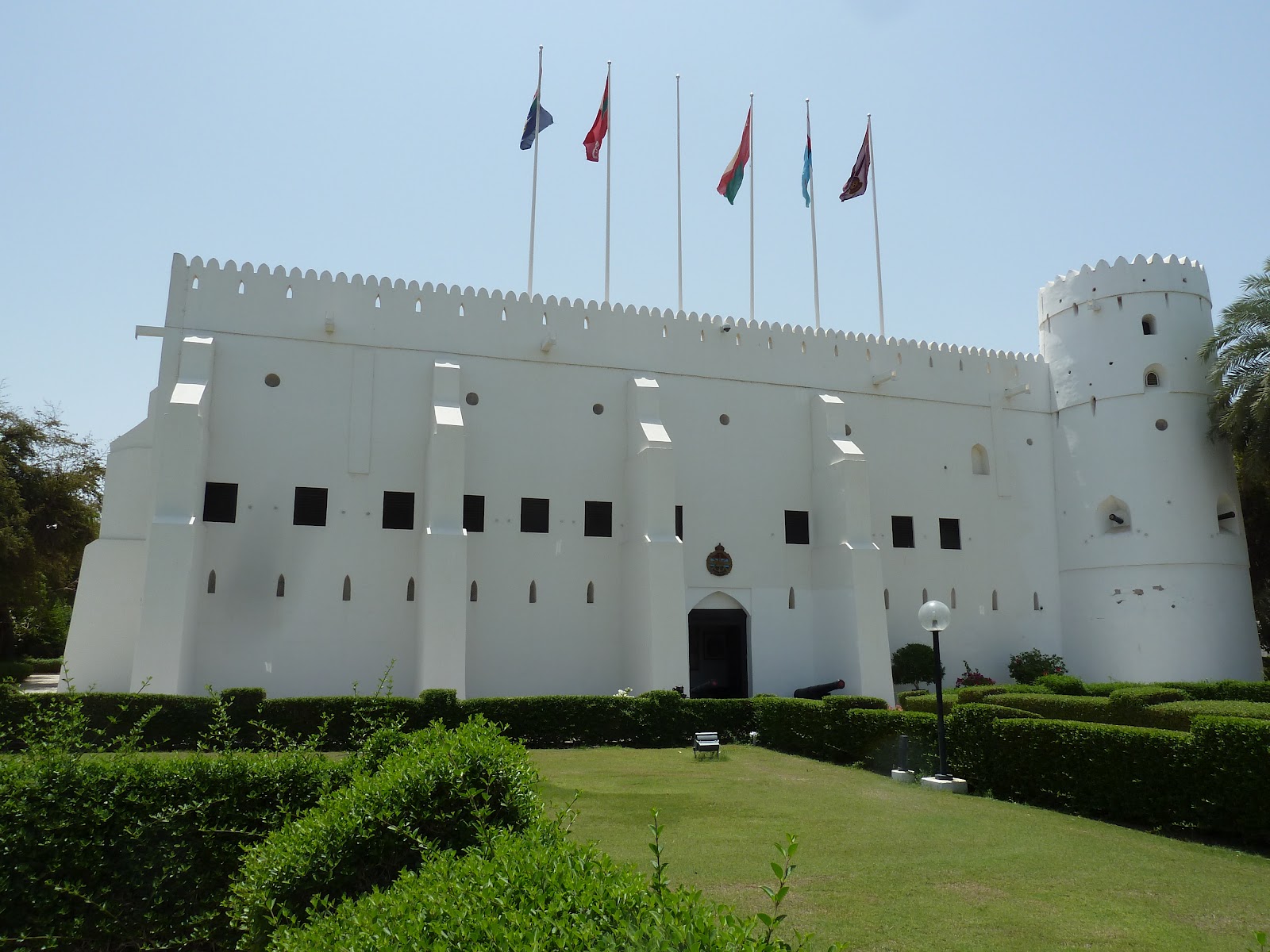
Since we had visited Muscat before, we did not want to do another city tour, but to re-visit (mostly at J's insistence) "The Sultan's Armed Forces Museum" (www.safmuseum.gov.om)  located in Bait Al Falaj Fort just inland from Mutrah and a short cab ride from the port.  The fort was constructed in 1845 at the narrow end of the Ruwi plain on the site of a falaj (well/irrigation system), from which the fort takes it name.  Until the 1980s, it was the headquarters of the Sultan's Armed Forces, and then it was converted into a museum.


The Sultan's Armed Forces Museum - Bait Al Falaj Fort
Built in 1845 by Sayyid Said bin Sultan as a summer house.


Falaj /Well at Site of Bait Al Falj Fort
Water is so beautiful in the desert!


Grounds and Outbuildings of the Museum
Desert, what desert?

We had invited our friends, Charlie and Kathy, to join us.  So, the four of us set out from the port by cab and 10 minutes later were at the museum's parking lot, walking among the manicured lawns of the museum's grounds.  At the museum door, we were met by a senior Omani soldier and escorted to the entry desk where we paid a nominal fee and were introduced to our guide.  Visitors are assigned a guide to escort them through the museum and to answer any additional questions not explained by labeling on the exhibits.  Our guide was a Royal Omani Navy yeoman who spoke (in addition to Arabic) Swahili, Buluchi, Persian, and English.  And, he quickly demonstrated an extensive knowledge of the museum's collections.

The museum is organized into a series of galleries on two floors of the fort.  The Gallery of Oman and Islam presents early military history up to Oman's role in the spread of Islam throughout Arabia and Persia.  There are Galleries devoted to the Portuguese in Oman, the Al Ya'aribah Period, the Al Busaidis (the Royal Family's history), Establishment of the Armed Forces, and the modern Omani Armed Forces, especially the insurgencies along the Yemeni border during the 1960s and '70s.  Because of the desert climate and local preservation of many weapons and other military artifacts, the exhibits are of the highest quality with very interesting items on display.  Regretfully, J did not take more interior images because he was too busy asking questions of the guide.  For detailed views of the exhibits and other collections at the museum visit the web site. (www.safmuseum.gov.om).


Fort's Original Canon, ca 1845.
Canons appear much older and may date to the 18th Century.


20mm  Russian AA Gun
Captured by Omani forces during Yemeni incident.

After two-hours in the air conditioned fort converted to a museum , with our guide explaining the history of Oman and its military, we were escorted outside to see Oman's obsolete military hardware that was too large for the interior of the building.   Another hour was spent looking at aircraft, patrol boats, tanks, and missile systems, mostly British.  Finally, we were escorted back into the fort, and a cab was called for us.  We had spent three and a half hours touring the museum (in our recollection, the most time we have ever spent on a single museum tour) and gained many interesting insights into the Sultanate.  E got the t-shirt.  J already had one.  The Arabic characters sometimes puzzle the neighbors when we wear the shirts on our morning dog walk in Kona.


Royal Omani Army Command Post


Omani Armor (Obsolete) on Display


Royal Omani Air Force Aircraft


Royal Omani Navy Guided Missile Patrol Boat
Not in water, mounted as a display!


Kathy and Eloise Pose with the Sultan's Armored Cadillac
Has been superseded, but appears to be in excellent condition.

On the way back to the port, we decided to stop at the Mutrah Souk to pick up a few local items for the upcoming Arabic dress dinner.  J and E are not fond of these kind of events, but they seem to be greatly in favor with certain cruise passengers (think British).


Mutrah Souk -- Scents and Footballs
Each shop seems to have the same things and no fixed price!

Almost every non-food item could be purchase in one section or another of the souk.  Of course, there were no fixed prices, except for gold which is always sold by weight based on a daily quote, and tourists were obligated to pay more.  J bought the makings of an Omani head dress (mussah), and was given lessons by the shopkeeper in folding the dishdasha and positioning it over the skull cap.  All quickly and neatly done by the shopkeeper, but not so by Jerry.  He needed a lot of practice.


Notions and Bangles for the Ladies
Leads one to suspect that under the burka may be a different world.

After about 30 minutes in the souk, we decided to return to the ship for lunch and a long afternoon nap.  Because that evening, after sailing from Muscat for Sufaga, Egypt on the Red Sea, we were invited by the Captain and Officers of the M/V Silver Whisper to dine in the Officers' mess.

At 7:30pm, eight of the world cruise passengers gathered at Reception on deck 5 and were escorted by the Food & Beverage and Hotel managers to the Captain's salon for pupus and drinks (cranberry juice for J&E).  Then, it was on to the Officers' Mess for an excellent dinner "below the water line."  All-in-all, a fancy Italian-style dinner for 12 -- 8 passengers and 4 officers, including theCaptain.  Needless to say, it was an Alka Seltzer night for J after that dinner.


Capt. Corsaro, J & E enjoy the pasta course, of course
Photo by Norman Rafelson, Hotel Director


Monday, August 20, 2012

The Land Common Sense Forgot


Fujairah, Dubai, United Arab Emirates (UAE)


Prepared August 20, 2012 at home Kona, Hawaii


April 9 and 10 at sea northern Indian Ocean enroute to Fujairah, UAE:  Back in Pirate Waters

Silver Whisper departed Mumbai at 11:00pm on 8 April heading west northwest.  We were back in pirate waters with the ship darkened and additional security in place.  Our next destination was the UAE port of Fujairah on the northeast coast of the Arabian Peninsula.  There were, of course, the usual lectures, entertainments, and special meals to distract passengers during our two-day crossing.  And, there was the rumor mill, which was busy with pirate adventures.  About the only real event was the Hotel Director Norman and F&B Manager Sujith's wine and cheese event to introduce a collage of images which they had taken during the cruise.  The collage was well done, and we have a copy somewhere in the house of mementos.

Our cruise across the northern Indian Ocean was uneventful and we docked in Fujairah, UAE at 8:00am on the morning of April 11.   One does wonder what would happen if pirates did board a cruise ship.   It would probably play out a little like John Hughes' novel, "A High Wind in Jamaica," with the pirates returning to their assault boats in a state of shock after being nearly heckled and nagged by the Mad White Women who make up most of the cruise passengers.  Remember, these women are experts; many of them have heckled and nagged at least one husband to death, and no small number have put down more than one.  No wonder pirates avoid cruise ships like the plague.  Note:  A movie version of "A High Wind in Jamaica" is available for the more image-oriented reader.


April 11 in port Fujairah, UAE:  A Visit to Lulu's

As described in the one piece of tourist literature provided to the passengers before disembarking, Fujairah is "the authentic Emirati city nestled between the Haja Mountains and the Arabian Sea."  The visual impact is of a number of modern buildings stuck in the desert.  Fujairah's primary function is to support tankers and other ships waiting outside the Strait of Hormuz to charter and load cargoes in the Arabian Gulf.   There are probably between 50 and 100 hulls anchored off Fujairah at any one time.


Fujairah's Skyline
Sorry about the sandstorm.

J & E's big adventure in Fujairah was to take the ship's complimentary shuttle bus to the Lulu Mall, City Centre.  The approximately 10 minute (five mile) trip from ship-side in the port to the mall was essentially a complete city tour without a guide's description.  Not a building looked over ten years, the streets were not congested, and the parking lots were so big you could get heat stroke walking from the lot to any of the buildings.  There may be some traditional Arab souks and forts in the area, but they are lost among the new buildings, roads and parking lots.

Lulu's is Walmart of the Arabian peninsula, and provides a shopping opportunity for ship's company and passengers to stock up on junk food and other "essentials" at reasonable prices.  This is where the local expats and foreign workers come to shop and to buy presents to sent back to Pakistan, Bangladesh, or the Philippines.  The amount of luggage, electronics and saris for sale was amazing.  No photos inside the Centre!  After taking in this local adventure in modern Gulf shopping, (J used an ATM machine and bought a box of pencils for the trivia team) we reboarded the shuttle and  returned to the harbor.  

Much of the rest of the day was spent observing activity in the port.  The most interesting point was speculating about the submarine, apparently under repair, tied up across the harbor from us.  I doubt if there was a single male passenger who didn't check it out with the binoculars provided in the stateroom.  Consensus  guess is that it was a British Navy nuk-boat undergoing some kind of repair or reprovisioning.  Here's an image -- make your own guess!


Name That Submarine
Tankers laying-off in the background.

At 5:30pm, we got underway and sailed north along the coast toward the Strait of Hormuz, and onto Dubai, UAE.


A Sandstorm Sunset on the Arabian Peninsula
Sorry about the spots on the image, a camera sensor problem.


April 12 and 13 in port Dubai, UAE:  Welcome to Cloud-Cuckoo Land

At 8:00am, the Silver Whisper docked at the Port Rashid Cruise Terminal in Dubai.  We had not planned any tour activity for Dubai, since we had been in the city many times since the 1980s when J advised a UN-supported project there.

Our big event in Dubai was to have high tea at At.mosphere Restaurant on the 121st floor of the Burj Khalifa, currently the world's tallest building.  With our friends Kat and Don, we left the ship about 2:00pm  and were driven to the Burj Khalifa.  After passing through several checkpoints, we were allowed to enter the building.


Burj Khalifa, World's Tallest Building
(Wikipedia stats.)
SkyscraperBurj KhalifaUnited Arab EmiratesDubai829.84m2,722.57ft201025°11′50.0″N 55°16′26.6″E

Since we were early for our reservation, we were "invited" to wait on the floor above the concierge desk until it was "time" to take the express elevator to the restaurant.  The floor above turned out to be the lobby of the flag ship Armani hotel, and old Georgio had done himself proud.  The lobby was all pale grays and other what E calls "Georgio colors."  (E is a big Armani fan.)


Escalator to Burj Khalifa Main Entrance
Yes, it is all glass and stainless steel.


Kat, Eloise, Jerry & Don, Armani Hotel Lobby
Glass, stainless steel, and Armani colors.

Precisely at 3:30pm, we were summoned to the entrance level, escorted aboard a very high-speed elevator, and shot up into the sky 120 floors.  If you were a religious person, you might have started praying about 30 seconds into this elevator ride.  About 60 seconds after leaving the lobby, we arrived on the 120th floor, and  were introduced to At.Mosphere's maitre d'.   She checked our reservations and led us to a table on the 121st floor, and tea was served.  Tea was very heavy, with two large tea trays filled and refilled with goodies until waddling was all the movement possible.


Decisions, Decisions!
Eloise faces the tea tray (one of two) at At.mosphere

Sadly, Dubai was in the midst of a sandstorm, so visibility was not great; however, the image that follows will give you some idea of how high up in the air we were.


Looking Down from At.mosphere
Covered area at left is the Dubai Mall


See, Guinness Says So!
World Record Certificate for "highest restaurant."

Back on the express elevator and the fun of falling like a rock for 120 floors - that could have unsettled all the food, but it didn't.  Then, the building concierge called for our car.  (We doubt that they would let you in  if you drove a private car!)  While waiting, J took a few more images of the Burj Khalifa's interior.  And then it was back in the car and on the streets to the Mall of the Emirates to watch some skiing!


Glass Panels and Louvers, Burj Khalifa's Lobby


Yard Art, Burj Khalifa's Lobby
You have to wonder whose cousin did this!

Back in the van, we were driven southeast toward the Mall, a super-sized, enclosed shopping center whose major claim to fame is that it houses the "Only Indoor Ski Slope in the Middle East -- Ski Dubai."  No foreign tourist worth their passport could possibly miss seeing an indoor ski slope in the middle of a desert during a sandstorm!  Our driver dropped us off, and after assuring us that we could find our way back to the pickup point, we began the trek through the endless cornucopia in this temple to excess consumption.  After walking for at least 15 minutes, we arrived at Ski Dubai.  Yes, a little Swiss Alpine village with ski and sled runs, lifts, and people in ski clothes.  All that was missing was Julie Andrews singing "Edel Weiss."   There were enough children about that no more were needed to sing the chorus.


Interior View, Mall of the Emirates
We have anything your heart desires for a price.


Looking into Ski Dubai
Think of it as a zoo for snow things.


Part of Ski and Sled Runs
Where is Julie Andrews when you need her.


Ski Dubai, Yes You Can Rent the Clothes
One suspects these outfits are not part of most locals' wardrobes.

After inspecting this triumph of engineering over common sense, and watching some attempts by paying customers to ski (not very well) down the run, we walked back through the mall and returned to our car just in time to participate in Dubai's rush hour(s) traffic, thereby enjoying an extended view of blowing sand from the car window. We eventually made it back to Port Rashid, tipped the driver, and walked up the gangway to the relative sanity of the Silver Whisper.

Our second day in Dubai was Friday the 13th.  Of course, we paid no great notice to this long-standing superstition.  After breakfast, we decided to join in what appears to be the singular most important recreational activity in the UAE -- visiting a mall! -- and boarded the Silversea shuttle bus to the Dubai Mall.  It is another super-sized enclosed building (acres under roof) located adjacent to the Burj Khalifa.  (The building where they serve tea.)  After a 15-minute bus ride from the port to the mall, the bus parked across from it in a vacant, very large bus-parking lot.  We were pointed across the street and told to walk until we found an entrance.  So much for Arab hospitality.  It doesn't extend to anyone not in a chauffeured limo (certainly not a bus).

The Dubai Mall is reputed to be the largest mall in the world with 1,200 plus shops.  However, one mall is very much the same as any other.  Except for lots of corridors with little foot traffic, thus facilitating a leisurely stroll, a stop for a cup of coffee at Starbucks, and buying some birthday cards, the whole experience was like Ala Moana in Honolulu, less crowded.  There was one challenge.  The structure is so large you can get lost!  We didn't, but we came close!


Dubai Mall Exterior
The number of people queued up to enter is amazing.


Botero Fat Horse, Dubai Mall Plaza
Not for sale!

The area between the mall and the Burj Khalifa consists of a courtyard and an artificial lake with waterfall.  This courtyard contains a piece of yard art by Botero.  Botero must have made a fortune doing yard art for new, "up scale" shopping areas.  There also is one -- a fat chicken -- in Singapore near the Fullerton Hotel and several fat nudes in the new Rupungi District of Tokyo.  Anyway, while J was taking his photo, one of our fellow passengers approached and explained that he had two Boteros.  J, ever the wit, said, "They must take up most of your living room."  Probably the humor was lost, but sometimes you can't resist!  J also holds that Botero is largely responsible for the growing number of fat people in the world.


Dubai Mall, Water Feature
Always hearing about the "Lion of Judah," this must be it!


Dubai Mall, Shopping Arcade
Please form orderly queues to enter the shops.


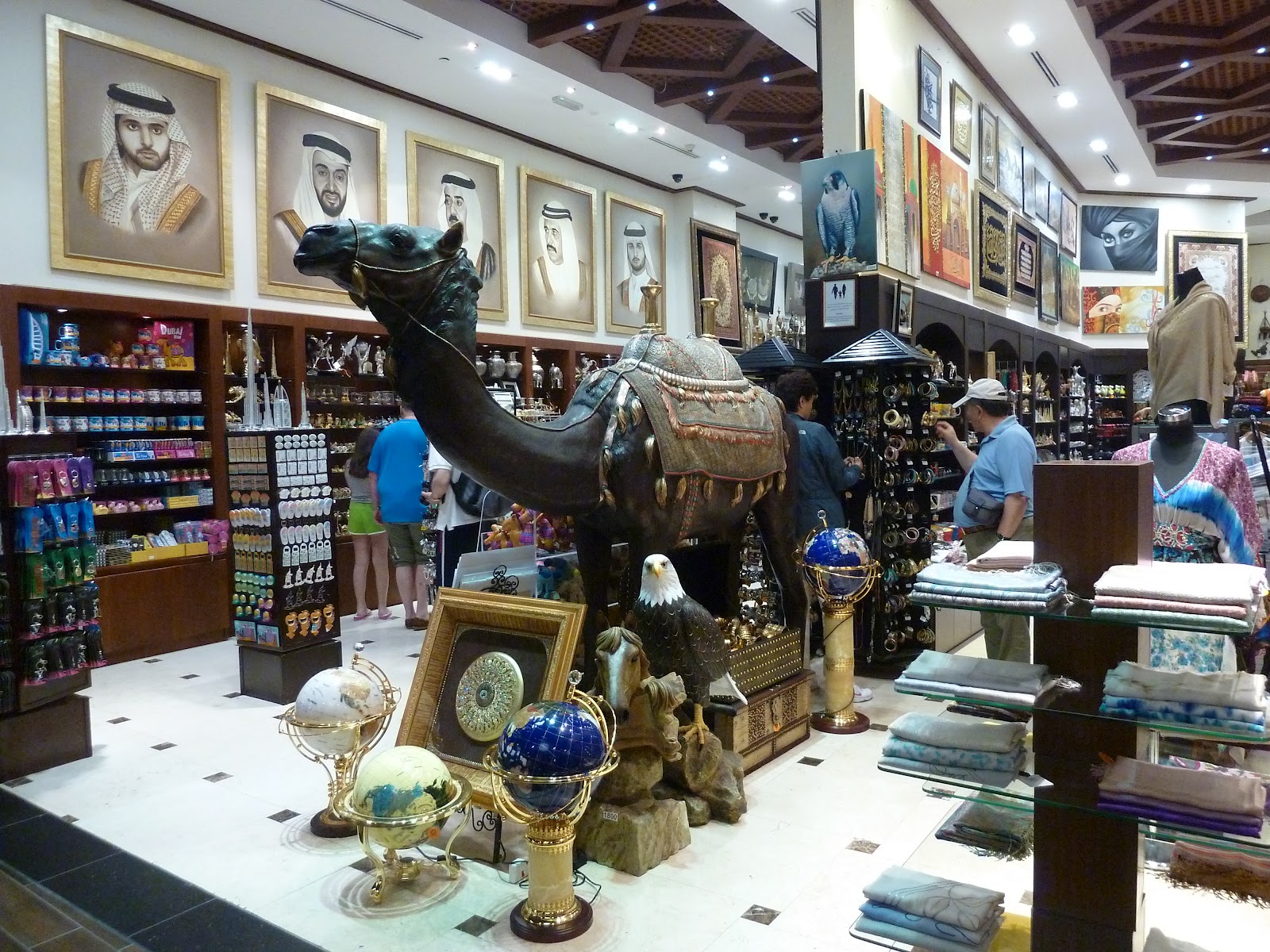
Dubai Mall, Curio Shop
It's not easy to get a stuffed camel aboard, but the live ones are two doors down!

With all our urge to shop gone, we trekked toward the shuttle bus in the noonday sun.  Taking our life in our hands, we crossed the street, entered the dust bowl parking lot, and boarded the bus for the trip back to port.  On return to the port, four (or more) additional cruise ships were docked, bow to stern.  There is a lot to be said for "build it and they will come."


The Silversea Shuttle
Cruise passengers' worst nightmare!


Cruise Ships, Port Rashid, Cruise Terminal
Which one is ours?

After lunch and a nap to recover from the "crowds" at the Dubai Mall, we played cards and went to tea.  At 10:30pm, we sailed for Khasab, Oman.


Mega Cruise Ship (Pacific Princess) Underway
Departing Port Rashid


Sunset Over the Arabian Gulf and Peninsula