Friday, February 17, 2012

Cape Town & The Garden Route -- Beauty and Beasts

Prepared February 16, 2012, in port Port Louis, Mauritius and en route Male, Maldives


February 3, 2012 South Atlantic Ocean en route to Cape Town:  A Farewell Party to Remember

Departing Walvis Bay, Namibia in the early afternoon of the previous day, we made south southeast toward Cape Town in moderate seas.  After the usual morning bridge lecture, writing on the blog, bridge play in the afternoon, and afternoon tea, a farewell dinner was held in the ship's restaurant for Richard and Patsy, our bridge-playing, tea-chatting friends, and occasional dinner companions since we had departed Fort Lauderdale.  They were to disembark in Cape Town to visit friends and family.

Formally attired, we arrived in the restaurant at 8:00 pm to be escorted to a table for 12 set for a place-card dinner.  As soon as we saw the place cards, we knew that this was going to be a very "special" dinner!  The cards were drawn by Polly, a very talented artist and crew member of the "Silver Queen" of the boat-building contest fame.


Name Cards for Guests Who May Forget Their Names!

In addition to Richard and Patsy, (the guests of honor) and ourselves, others included Polly (artist of note), Joe, Mike and Viv, Ted and Pauline, Camilla, and Sujith.  After wine was served, toasts were made, some re-made, and stories told.  Dinner was served (lamb for J and fish for E), and conversation flowed like the wine.   At about 11:00pm (an hour after the restaurant closed),  the happy band staggered to their cabins (the ship seemed to be rolling more than normal)  to rest for the arrival at Cape Town.


February 4, 2012, South Atlantic Ocean and Cape Town, South Africa:  The Lost Hotel and the Hunt at Victoria and Albert Waterfront

As we approached Cape Town, the swells diminished, and the weather cleared.  Silver Whisper stood off the harbor waiting for the harbor pilot and a berth, so we had a clear view of Table Mountain and the City of Cape Town.  Finally, the pilot boarded, and we entered Duncan Dock harbor to be greeted by a seal who watched the entire docking as if he were the pilot!  Then, the South African immigration officials boarded, we were inspected (stamp, stamp) and allowed to disembark.  (Another country fearing mass cruise ship passenger immigration?)


Cape Town & Table Mountain from Seaward

Having docked and been cleared, it was time to begin our six days of South African shore leave!  Having packed our safari gear (except E's hat, an oversight), and collected our passports, it was down the gang plank and into the cruise terminal, where we were promptly cornered by South African Ag inspectors in search of illegal fruits and nuts. (Sounds like Hawaii.)  None were found, so we passed out of the terminal to be greeted by a driver who was to take us to our Cape Town hotel, where we were to stay until our flight to Port Elizabeth early the next morning.

Into the air conditioned car to escape the 95 Deg F plus heat and off we go to our hotel - The Queen Victoria - which had been organized by our friend from White River, Ethne.  Arriving at the hotel to check in, we were escorted to reception, waited the requisite twenty minutes, and were delicately informed that we were at the WRONG hotel.  This was the Victoria and Albert, not the Queen Victoria;  however, they were owned by the same firm, so it was back into the car up hill behind the Victoria and Albert Waterfront, and finally to the QV!  The QV is a recently-opened, boutique hotel, and definitely worth getting the name straight!

After settling into our room, we set off to the huge shopping and recreational complex known as the Victoria and Albert Waterfront.  The main object was to try and find a pair of "fit-over" sunglasses for J, because his transition lenses are not up to the bright light of the southern hemisphere in summer.  Well, the search was unsuccessful, although J did find an alarm clock (ZAR 10.00 ~US$1.50) to use while on safari and replace the digital monster that is in the suite on the ship.

As good fortune would have it, we literally ran into Richard and Patsy in the W&A shopping center, and invited them for tea at the Queen Victoria Hotel.  We trekked back up the hill to the hotel and adjorned to the lobby bar, where tea was organized with sandwiches and cookie treats.  After talking story for an hour or so, our friends headed off to meet other friends at the W&A Waterfront, and we went to our room for a long, long shower in a giant bathroom that didn't move.  It was a short night's sleep before the 5:30 AM wake-up call for our car ride to the airport and flight to Port Elizabeth.


February 5, 2012, Port Elizabeth, Plettenberg Bay, South Africa:  Walking the Animals and The Good Life of the Garden Route

On checking out of the Queen Victoria, where the proffered breakfast ended up being a cup of strong coffee and nothing more, there was an early morning drive through Cape Town to the Airport.  Check in for the SAA commuter flight to Port Elizabeth was painless and even the airport security check was accomplished without the TSA's surly intrusiveness.   With less than 10 passengers on the early morning commuter jet, the one hour flight was comfortable and the box breakfast was edible.  It helped to be hungry.

Recovering our bags at Port Elizabeth, we were met by Gareth.  He was to be our driver/guide for the next two days of touring along the Garden Route from Port Elizabeth to George.  (Highwary N2 follows the Indian Ocean coast from Cape Town to Port Elizabeth.)   Turning west on N2 toward Plettenberg Bay, we drove for about 2 hours to the Storms River Bridge.  The Storms River is in a deep gorge marking the beginning of the Garden Route's numerous national parks.


Storms River from Storms River Bridge

For lunch, we stopped at Bramon Wine Estate.  Although neither of us drink, we had a wonderful meza-style lunch of salad, cheeses, meats, pates, and homemade fresh bread.  Truly bountiful travelers' fare.


Lunch Among The Vines
Eloise and Guide Discussing

After lunch and a short stop at the Mill Mohair and Decor Centre (so E could pet the angora goats and J buy a pair of formal socks), it was off to the Elephant Sanctuary, and a walk with the elephants.  The African elephants, which have been at the Sanctuary since they were orphaned, have been trained to obey the commands of their handlers and can be touched and closely inspected by the tourists.  The high point is "walking" with the elephant while holding his trunk.  This entire experience lasted about an hour, including a lecture by one of the handlers on elephant physiology.


Petting the Angora Goats


Walking the Elephant (Sabo)


Elephants on Parade


Hand Feeding the Elephants

After the elephants, it seemed unlikely that any wildlife adventure could top that experience.  However, our next stop at the Tenikwa Wildlife Awareness Centre did just that.  Our walk with the cheetahs was amazing!  Arriving in the late afternoon, we waited for about a half-hour, watching meerkats and land tortoises that had been recovered from individuals who were keeping them as illegal pets.  We were then given a briefing on cheetahs and ground rules for walking them -- 1) No sun glasses, cigarettes, or purses/bags; 2) Cheetahs first, you follow;  3) Obey the handlers; 4)  If the cheetah decides to run, drop the lead and watch him "go"; and 4) If the cheetah stops and lies down, you stop, and wait.  Lying down is optional.  After the briefing and signing the obligatory disclaimer form, stating that the Centre is not responsible in any way for any thing, it is off to meet the cheetahs.

Mr. Meerkat Takes His Leisure


Land Tortoise on the Move! (Maybe)

Our party consisted of five tourists, two handlers, and two cheetahs (Chester and Sachi), which we were taking for their evening walk in the woods.  Each cheetah was on a harness with two 10 foot leads.  Usually, you walked beside the animal or closely behind it.  So, for one hour plus, even though the cheetahs did a lot of lying about, we walked along unimproved woodland trails with the two cheetahs leading the way.  There were many stops so it wasn't too strenuous, and since it was later in the day, the temperature was down.  We also stopped to give the cheetahs water, but they were to be fed after returning to their enclosures.  The whole experience was like walking a very big domestic cat.  They generally went where they wanted.  Most of the time,  their handlers would convince them to take certain paths, but when it was rest time, it was rest time!


Walking the Cheetah


Let's All Have a Rest


Cheetah Checking Out the Neighborhood
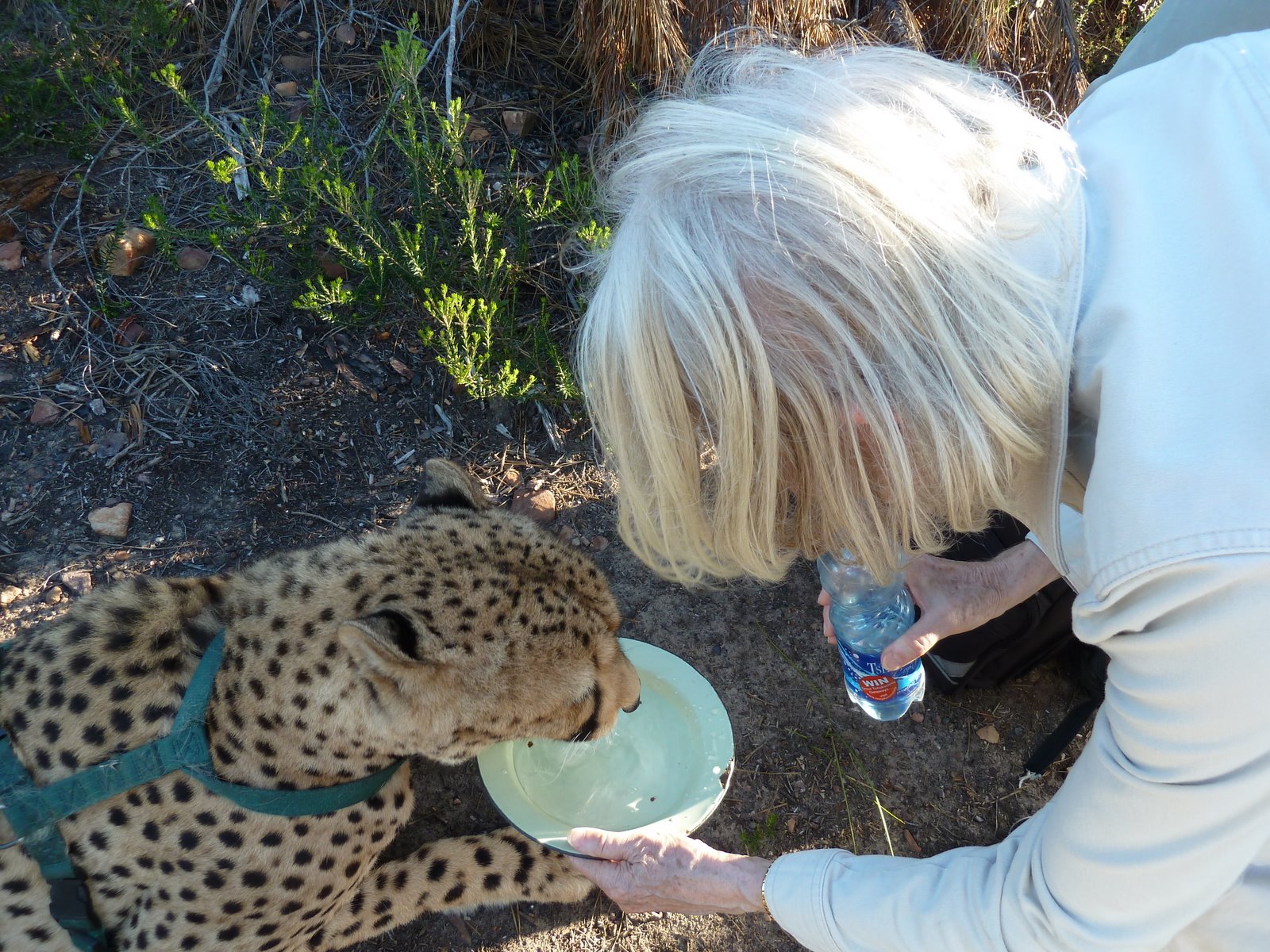

Cheetahs Prefer Bottled Water


Time for Another Little Rest -- No Objections?

After returning to the the Centre's building, we had a snack and returned to the car for the hour's drive to Hunter's Country House, where we spent the next two nights.  Passing through Plettenberg Bay, we drove down an improved gravel road to a gate house and onto the Hunter's property, where there are two lodges and a restaurant.  We stayed in one of the cottages on the property.  The whole property reminds you of an English country house surrounded by exquisite formal gardens.  We arrived just at night fall and did not fully appreciate the beauty of the landscaping until the next day.  Also, we were too tired to do much except eat a late dinner at the restaurant, shower, and fall exhausted into bed with dreams of elephants and cheetahs dancing in our heads.

To be continued....
Posted by Picasa

Sunday, February 12, 2012

Walvis Bay, Swakopmund and Dune Dining

Prepared February 3, 2012, South Atlantic Ocean, enroute to Cape Town and continued February 12, 2012, Southwest Indian Ocean enroute to Fort Dauphin, Madagascar

January 30 and 31, 2012, at sea, South Atlantic Ocean, bound for Walvis Bay: Boat Building and Reunions
After departing Jamestown, St. Helena, we steered southeast toward the coast of Africa and our next port of call, Walvis Bay, Namibia. The longer we are at sea, the more nautical terms creep into this blog!
Both days, there were bridge lessons and play, as well as trivial pursuit. Bridge has expanded to nine tables of duplicate play and one table of beginner rubber play. J & E continue to improve, sometimes. There are very few non-bridge players who would intrude into the card room during match play. It would be a little like entering the dragon's den, but on January 31, one hardy soul did break tradition. She came parading through the card room wearing a sandwich board advertising one of the boat's (Silver Queen) in the upcoming boat building contest. The bridge players were so impressed by the sandwich board lady's bravery that they agreed to play a few less boards (hands) and to attend the contest.


The Silver Queen -- Captain Fluffy & Crew
Guess which one is crew!

Boat building contests have relatively few rules. Passengers form teams (any number per team), and using trash (politically correct term: recyclables), they build a boat that must carry cargo (full beer cans) and stay afloat for 60 seconds with the cargo on board. Senior ship's officers, including the Captain, act as judges and award extra points for boat-like appearance, etc. Originally, four teams were formed, but only two boats made it to the pool deck in time for the competition. The other two failed to launch. One of the competitors was the "Silver Queen," based on a Mississippi river boat design, and the other was "Fernando's Hideaway," which boat bore a striking resemblance to a life preserver with an orange plastic laundry bag on top.

With some ceremony, the first boat (Silver Queen) was launched into the swimming pool, and with the assistance of the cruise director, Fernando, beer and soft drink cans were loaded aboard. About 60 cans were loaded, the boat floated for the required 60 seconds, and the cargo was removed.


Loading "Cargo" on Silver Queen

Next, Fernando's Hideaway was launched with great ceremony, including a singing mermaid who sang, you quessed it, Fernando's Hideaway! In the pool, 60 cans were loaded and the float test was passed with ease. The decision now rested with the judges. Long consideration was given, and first place was awarded to the Silver Queen with a winning score three points more than Fernando's Hideaway. There was some grumbling from supporters of Fernando's Hideaway, but all ended with good cheer from boat builders and observers alike.


The Mermaid of Fernando's Hideaway


Fernando's Hideaway -- It Floats!

On the evening of January 31, those of us who had cruised together on the 2007 World Cruise had a cocktail party before dinner. About 25 of current cruisers were on the 2007 World Cruise, so there was a lot of discussion about things that happened back then. It was good to see people with whom we had previously cruised and had not yet encountered (believe it or not!) on this ship.


February 1 and 2, 2012, in port, docked at Walvis Bay, Namibia: Not the Africa We Knew

By mid-day February 1, we had begun the long approach up the marked channel in Walvis Bay Harbor where the ship docked . As at Guanabara Bay, oil rigs and drilling support ships were much in evidence in Walvis Bay. After the ship tied up, aboard came the Namibian Immigration officials for a face-to-face inspection of each passenger before the ship could be cleared. Now we know what US Aid money is used for -- to train African immigration departments in US Immigration methods. When the inspection and passport stamping was finally completed, we were cleared to go ashore. There must be a HUGE amount of illegal immigration from cruise ships here!

Ashore, we boarded tour buses for the trip to Swakopmund, the old port of German Southwest Africa and now a tourist resort about 25 km north along the Atlantic coast from Walvis Bay. The bus was specially adapted for Namibian desert touring, with raised and stiffened suspension and the engine mounted in the front to cut down on dust -- think 40-passenger Land Rover!  After a short bus tour of Walvis Bay and a visit to the commercial salt pans to see flamingoes (they had left the day before we arrived!), it was off to Swakopmund along the coastal highway, with the Atlantic beaches on the left and 100 to 500 ft. sand dunes on the right.


Walvis Bay Salt Pan
Where are the Flamingoes?

For those of us with previous African exposure, Swakopmund was a shock. Somehow it has retained that Teutonic tendency for order and cleanliness which has never been of much concern in the rest of Africa. Our tour's first stop was at a rock, mineral, and crystal display at the Kristall Galerie. The Kristall Galerie's claim to fame is a 14-ton rock crystal cluster held to be "the World's largest." Actually, the crystal displays were interesting, but the main purpose was to get our shopping elements into the Galerie's store so that some "rock" could be sent overseas.


The "World's Largest" Rock Crystal

Having survived this commercial encounter, we were on our way to the old part of Swakopmund to visit the local museum, look at the early German government buildings, and see the old railroad station. We also spent part of our afternoon in a German bakery, eating cakes and drinking coffee/cocoa. The tour did show us the town and its late 19th and early 20th Century buildings.


19th Century Lutheran Church


Government Administration Building
Formerly German Insane Asylum -- No Comment!

About 6:00pm, it was back on the bus and off across the desert to a Silversea Experience "Dinner in the Desert." Driving about 45 minutes along the back side of the sand dunes on unpaved roads, the bus took us up into an area between several dunes.  There large tents were clustered around a central plaza.


Giant Sand Dune

Climbing down from the buses, we were met by the sight of camels available for our riding pleasure. Bypassing this opportunity to be spit upon and bit, we headed for a reception line, where local ladies in traditional costumes greeted us with libations of several sorts (fruit punch for J&E). Our travel thirst quenched, we watched school children sing and dance for us, as we were led into large tents and seated for dinner. Dinner of local food stuffs -- vegetables, seafood, fish, meats -- was excellent, and about 10:00pm, we were shepherded back on our bus to return to Walvis Bay and the ship.


Camels -- Keep Your Distance!


Greeter in Local Costume


Local School Singers 

Since we were not to sail for Cape Town, South Africa until 1:00pm on February 2, J&E decided to take the ship's shuttle bus into Walvis Bay to shop for a shoe horn. Yes, a shoe horn! Walvis Bay is a modern, well planned and maintained city with shopping centers and all the other aspects of 21st Century urbanity. But, shoe horns, it appears, have not become a fixture of local life, and finding one turned into a bit of an adventure. J&E visited four or five shoe stores before one sales lady said she might have a shoe horn in the back. After a long wait, she returned with a plastic shoe horn that was a promotional item for a brand of shoes.  She refused to accept payment. We also investigated "fit-over" sun glasses for J, but they were not to be found. So, off we went to the shuttle bus and our return to the ship.

The Silver Whisper took in lines, and we sailed out of the harbor, back down the channel, setting course south southeast for Cape Town.
Posted by Picasa

Wednesday, February 1, 2012

Five Days at Sea and St. Helena

Prepared January 31, 2012, South Atlantic Ocean, en route to Walvis Bay, Namibia


January 24 to 28, 2012, At sea South Atlantic Ocean, bound for St. Helena Island:  All At Sea

Five continuous sea days is a long at-sea period for a cruise ship.  In most cases, the ship is in port or anchored almost every second day.  Probably  the cruise lines don' t want the passengers to run out of things to do and get restless or bored.  However, longer periods cannot be avoided when crossing the vast majority of the South Atlantic Ocean bound for Africa.

Excluding eating and sleeping, the daily routine varies from person-to-person.  J & E play bridge and trivial pursuit.  Other passengers take to the sun on deck chairs near the pool deck bar, and still others attend "enrichment lectures" on wide-ranging topics from astronomy to international affairs.  While the younger and friskier passengers have international affairs!   Anyway, everyone stays occupied, and there are very few complaints about days at sea.

The crossing from Rio to St. Helena is not a heavily-trafficked sea route.  We did not see a single vessel the entire time, and any small thing, a bird or fish, causes great excitement.  An example of this was the sighting of Illas Martin Vaz, an exposed rock situated along the mid-Atlantic ridge.  Under normal circumstances, this rock would not have elicited as much excitement, but having not seen anything but water for two or three days, the rock became an object of great interest.  The cruise director announced its sighting, and the masses rushed forth (digital cameras in hand) to photograph one of the most uninteresting rocks ever sighted by sailors.  Only if you are a bird could you like this place!

Illas Martin Vaz -- Birds Wanted!
Illas Martin Vaz's only claim to fame was a minor role in one of Patrick O'Brian's Master and Commander novels, when Maurtrin is stranded on the rock while bird watching, and Aubury has to return with HMS Surprise to rescue him.  Well, it is a sort of fame.

As we began the last sea day before St. Helena, there was a noticeable increase in enthusiasm for going ashore.   The cruise equivalent of rock fever had not set in, but some early symptoms were seen in the passengers' eagerness to visit a slightly larger rock on the eastern side of the South Atlantic -- St. Helena.


January 29, 2012, at Anchor off Jamestown, St. Helena:  Visiting Napoleon's Last Abode and His Friend, Jonathan


Sunday Morning and land ho, anchored off Jamestown, St. Helena's largest town, capital, and only port.  From seaward, St Helena gives the impression of an arid island with high cliffs dropping directly into the South Atlantic.  At sea level, the island is dry, but at 1,000 feet and above, it becomes a wet, semi-tropical landscape of green trees and flowers.

St. Helena and Jamestown from Seaward
Once we have been tendered ashore, the "tour" buses are waiting.  Actually, every wheeled vehicle that could be considered a bus is waiting, and so we pick a 16-passenger van for the tour to Napoleon's tomb,  Longwood House, Plantation House, and other local sights.  The paved roads are one lane, with turnouts for down hill traffic (up hill traffic has the right-of-way).  They consist of a series of switchbacks leading up from the port and Jamestown to the relatively flat, moist tablelands that make up the Island's green (cropped, pastured or forested) interior.
The Landscape on Top

Jamestown and James Bay from the Top

After several stops along the road for explanations by in-place, local guides, and opportunities for photos of Jamestown, James Bay, and the Silver Whisper, we arrive at the site where Napoleon was buried before his body was shipped to Paris and reinterred.  His original tomb is about 3/4 of a mile down a grass lane from the paved road where we disembarked from the bus.  The downhill walk to the tomb is a pleasant morning stroll, and the tomb itself is well maintained.  All-in-all as fine a place as any to be buried.

The Sign Says It All


Napoleon's Original Tomb
Note the Flag -- Not the Union Jack!

The local groundskeeper was busy removing large needles fallen from the nearby Norfolk Island pine trees, which were planted near the tomb.  Norfolk Pine needles kill all other plant life underneath their branches, as J & E can attest from their experience with the Norfolk Pine that formerly grew in their back yard! (Big spot of bare soil!)  With the groundskeeper was his 2-year old, tethered Border Collie, whose interest in pine needles was minimal, but who wanted his master to play with him.  Border Collies are not big on things that don't move.

Got Sheep?
After the leisurely stroll down to the tomb, the real challenge was the plod UP to the bus.  It was touch and go, with lots of mind talk about how did I get in this bad shape, etc., but we made it back to the bus only slightly out of breath.  Then we were off to Longwood House where Napoleon lived during his exile on the Island from 1816 to 1821.  Longwood House is no palace, but it was a very comfortable house in the subtropics with extensive gardens.  Not prison-like at all, except that Napoleon could not leave.  Photos were not allowed inside the house, but a tour guide was available in most rooms (about 10) to explain their function and furnishings.

Longwood House
The Usual Suspects in Longwood House Garden
Note the Matching Bags -- How Hilo Hattie!
After Longwood House, we went to visit Jonathan, according to locals, Napoleon's only living friend.  Jonathan is an approximately 200-year-old Seychelles turtle.  He may (or may not) have actually seen Napoleon.  One suspects that Jonathan doesn't really care one way or the other.  He and his 3 younger relatives live in the garden of Plantation House, which is the residence of Her Majesty's Governor.  St. Helena is still a self-governing territory of the United Kingdom.

Hello, My Name is Jonathan

Jonathan's Friends

Our final stop was at the top of Ladder Hill, where the upper portion of Jamestown is located 700 feet above the lower, sea-level portion.  The two parts of the town were once connected by a tramway, but all that is left is the step-like concrete structure that was under the track.  This forms a 699-step walkway known as Jacob's Ladder.  Several of the younger guests and crew members walked down (still hobbling two days later aboard), but to our knowledge, no one walked up!

Jacob's Ladder
Yes, it is a long way down!

Finally, it was back to the Main Street of Jamestown.  Even though a Sunday, all along Main Street the shops were open to celebrate the semi-annual cruise ship.  However, we only had time to walk back rather quickly to the port area and tender at Wharf Steps.  Returning to the Silver Whisper for lunch (no missed meals), up anchor, and sail-away to Walvis Bay, Namibia.

Main Street, Jamestown, St. Helena

The Archway
Entry to Jamestown from Port 


M/V Silver Whisper at Anchor,
James Bay, St. Helena


Posted by Picasa

Monday, January 30, 2012

Leaving Rio de Janeiro

Prepared January 28 and 30, 2012 South Atlantic Ocean, en route to Jamestown, St. Helena and Walvis Bay, Namibia

In Port and at Sea, January 23, 2012  Rio de Janeiro,  Guanabara Bay, and South Atlantic Ocean:  Finding a Cobbler in Copacabana

Sleeping late to recover from the previous day's urban safari, we fought our way through the masses dissembarking and wandering around lost from another Costa VLHC (VLHC -- Very Large Human Carrier as compared to a VLCC -- Very Large Crude Carrier).  Then, walking quickly and looking straight ahead, we pass through the gauntlet of jewelry salesmen and finally reach the 60-passenger shuttle bus for the one-hour trip from the cruise terminal to the Copacabana section of Rio de Janeiro.

J & E are on a mission.  E's dress shoes had lost their heel caps when she wore them to a formal-night cocktail party and dinner.  So, the heel caps must be replaced at all costs -- including a one-hour bus ride in Rio's Monday morning traffic!  Before we left the ship, we had been given directions by the local on-board travel consultant.  She had telephoned and talked and finally come up with two approximate addresses somewhere in the Copacabana district for cobblers.  The street names and directions were, however, a little vague, or possibly failed to make the transition from Portuguese to English.  Thus, the Monday morning Silversea shuttle bus trip to Copacabana at about 10:00a.

The shuttle bus dropped us in front of the Othon Palace Hotel on Atlantic Avenue across from Copacabana Beach.  Speaking with the bellman, it was determined that there was a shoe repair shop about five blocks away on D. Ferreira Street -- well within walking distance.  So, off we went to the shoe repair shop, which we found with no trouble.  The cobbler was present, and after an interesting, multicultural show-and-tell, the nature of the repair was established (new heel caps), the price (~US$ 15.00), and the time (about two hours).  This took some effort because the cobbler was Italian, speaking only Italian and Portuguese, and we spoke neither.  But, with the help of the cobbler's friend, who thought he spoke some English, all was arranged.  It also helped that the shoes in question were Italian made (Ferragamo), and national honor was involved in their repair.

Since we had to wait for the shoes, we decided to walk along Atlantic Avenue (opposite Copacabana Beach) to the Copacabana Palace Hotel for a coffee and some treats.  This was a longer walk than we had anticipated in the hot mid-day sun.  J and E will never learn!   But, the hotel was cool and a good place to wait, over a cappuccino, fruit and breakfast rolls.  The only glitch was that we arrived at the time of a staff changeover, so it took awhile to get waited on and served.  If you want it fast, go to McDonald's!


Copacabana Palace from Atlantic Avenue

To stay in the shade, we walked back along the interior streets and looked at the shops.  Sadly, from the point of the Brazilian economy, nothing was purchased.  Arriving at the shoe repair shop, the shoes were ready.  After inspection and E's declaration that all was correct and in order, the shoes were wrapped in a plastic bag and placed in a book bag for transport back to the ship.


Atlantic Avenue's Wave Design Sidewalk Paving

The next Silversea shuttle bus was not to arrive for about an hour, so we sat in the Othon Palace Hotel's side lobby until it came.  The return bus trip to the Cruise Terminal was only 20 minutes.  On arriving at the terminal, we experienced another example of mass tourism run amok.  But, with the assistance of the ship's crew, we successfully boarded the Silver Whisper in time for our 6:00pm departure from Rio de Janeiro.

We had been moored next to the Brazilian naval piers in Cais do Porto, and on departure, J got to see an old acquaintance:  the Brazilian navy's aircraft carrier (BNS Minas Gerias).  The Minas Gerias had been anchored off Rio, along with the USS Yorktown, when the Yorktown made a port visit to Rio de Janeiro in 1969 at Carnival.   Hopefully, the Minas Gerias, like the Yorktown, is now a naval museum!


BNS Minas Gerais


Brazil's Naval Academy

On the track down Guanabara Bay to the Altantic, we again saw the Petrobas oil production fleet with oil rigs and drilling ships.  After passing through the mouth of the Bay, we entered the Atlantic and set course for St. Helena Island, a five-day cruise to the east northeast.


Goodbye Rio de Janeiro!
Posted by Picasa